

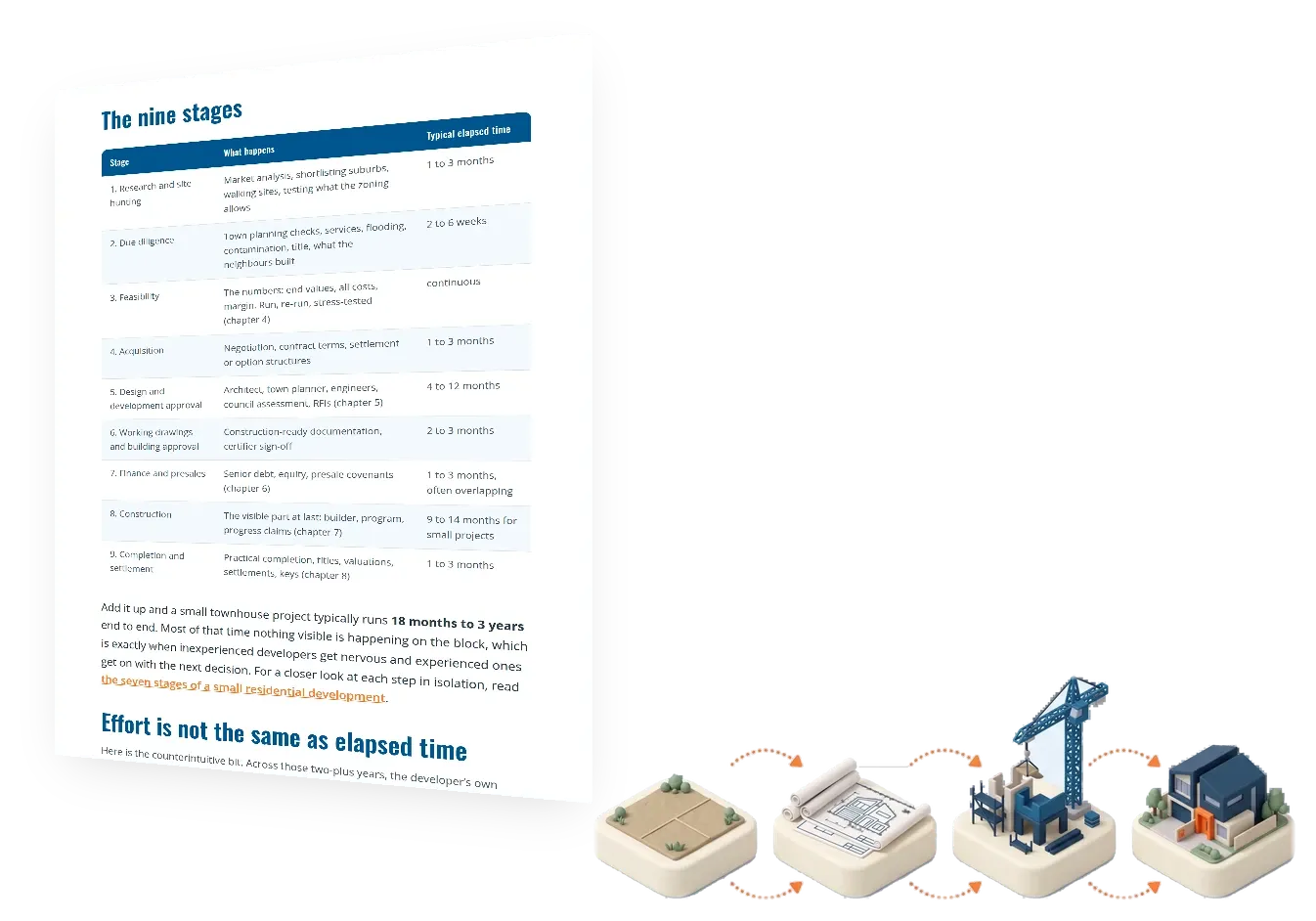
How long does a property development take? The nine stages
| Stage | What happens | Typical elapsed time |
|---|---|---|
| 1. Research and site hunting | Market analysis, shortlisting suburbs, walking sites, testing what the zoning allows | 1 to 3 months |
| 2. Due diligence | Town planning checks, services, flooding, contamination, title, what the neighbours built | 2 to 6 weeks |
| 3. Feasibility | The numbers: end values, all costs, margin. Run, re-run, stress-tested (chapter 4) | continuous |
| 4. Acquisition | Negotiation, contract terms, settlement or option structures | 1 to 3 months |
| 5. Design and development approval | Architect, town planner, engineers, council assessment, RFIs (chapter 5) | 4 to 12 months |
| 6. Working drawings and building approval | Construction-ready documentation, certifier sign-off | 2 to 3 months |
| 7. Finance and presales | Senior debt, equity, presale covenants (chapter 6) | 1 to 3 months, often overlapping |
| 8. Construction | The visible part at last: builder, program, progress claims (chapter 7) | 9 to 14 months for small projects |
| 9. Completion and settlement | Practical completion, titles, valuations, settlements, keys (chapter 8) | 1 to 3 months |
Add it up and a small townhouse project typically runs 18 months to 3 years end to end. Most of that time nothing visible is happening on the block, which is exactly when inexperienced developers get nervous and experienced ones get on with the next decision. For a closer look at each step in isolation, read the seven stages of a small residential development.
The property development process is judgement, not labour
Here is the counterintuitive bit. Across those two-plus years, the developer’s own hands-on hours on a small project can total only a few working weeks. The architect, engineers, planner and builder put in the thousands of hours. The developer contributes judgement: which site, which design, which builder, which price, when to hold and when to walk. It is why some experienced developers run projects alongside a day job. It is also why judgement, not effort, is what you are really backing when you back a developer.
The catch, and it is a serious one, is that every stage above is a place where money leaks if the judgement is wrong. The next five chapters take the highest-stakes stages one at a time.