

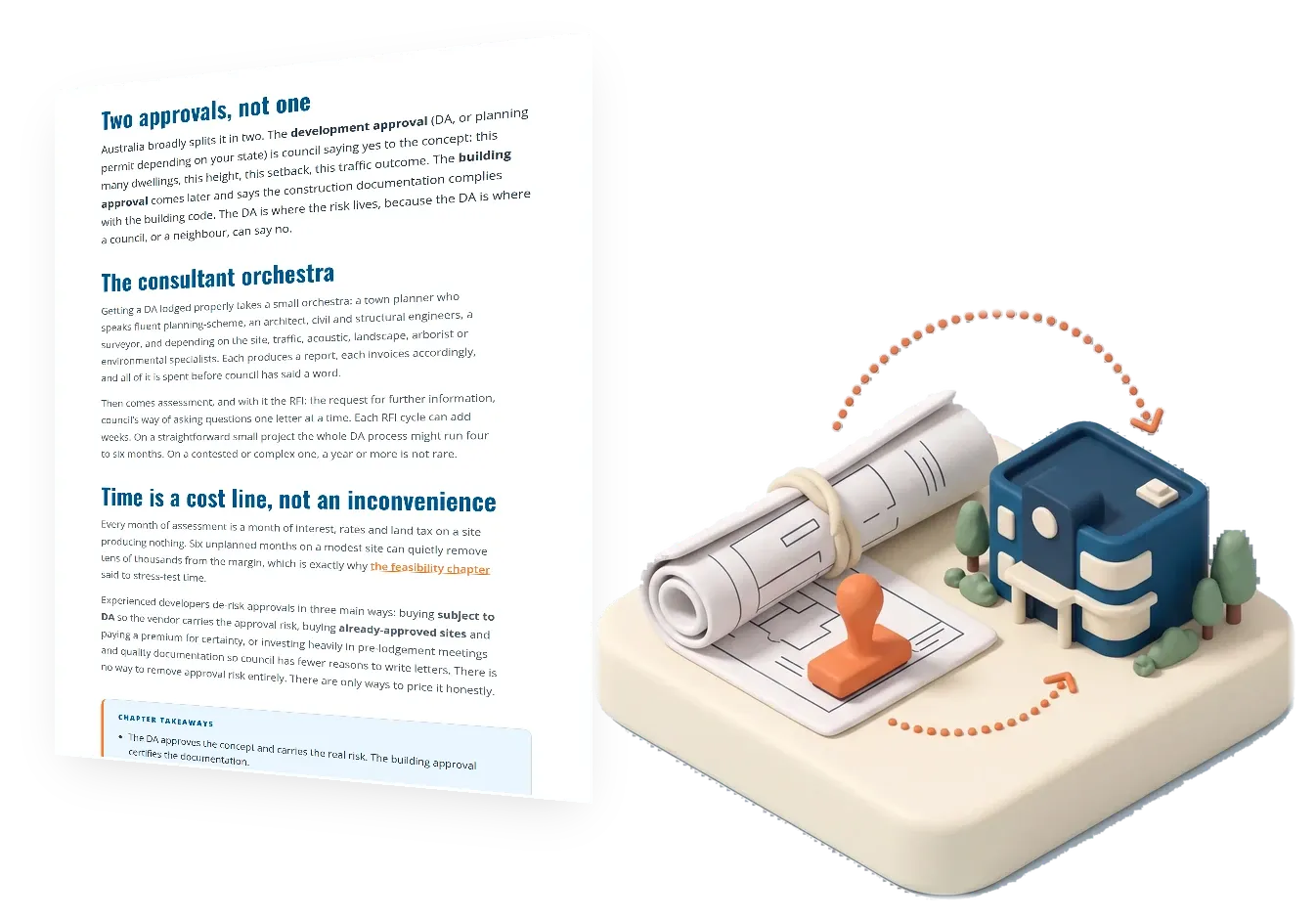
DA and building approval: a development needs two, not one
Australia broadly splits it in two. The development approval (DA, or planning permit depending on your state) is council saying yes to the concept: this many dwellings, this height, this setback, this traffic outcome. The building approval comes later and says the construction documentation complies with the building code. The DA is where the risk lives, because the DA is where a council, or a neighbour, can say no.
The consultant orchestra
Getting a DA lodged properly takes a small orchestra: a town planner who speaks fluent planning-scheme, an architect, civil and structural engineers, a surveyor, and depending on the site, traffic, acoustic, landscape, arborist or environmental specialists. Each produces a report, each invoices accordingly, and all of it is spent before council has said a word.
Then comes assessment, and with it the RFI: the request for further information, council’s way of asking questions one letter at a time. Each RFI cycle can add weeks. On a straightforward small project the whole DA process might run four to six months. On a contested or complex one, a year or more is not rare. Small projects increasingly have a faster lane: Victoria’s VicSmart now covers many two-lot subdivisions with a 10 business day clock, and New South Wales fast-tracks dual occupancies and terraces as complying development. We set out those small-lot routes, and what the fees come to, in what it costs to subdivide land.
Time is a cost line, not an inconvenience
Every month of assessment is a month of interest, rates and land tax on a site producing nothing. Six unplanned months on a modest site can quietly remove tens of thousands from the margin, which is exactly why the feasibility chapter said to stress-test time.
Experienced developers de-risk approvals in three main ways: buying subject to DA so the vendor carries the approval risk, buying already-approved sites and paying a premium for certainty, or investing heavily in pre-lodgement meetings and quality documentation so council has fewer reasons to write letters. There is no way to remove approval risk entirely. There are only ways to price it honestly.