

The FracHaus Guide
The honest guide to property development
How developers really make money, why it is harder than it looks, and how ordinary investors can sit on the developer's side of the table with their eyes open.
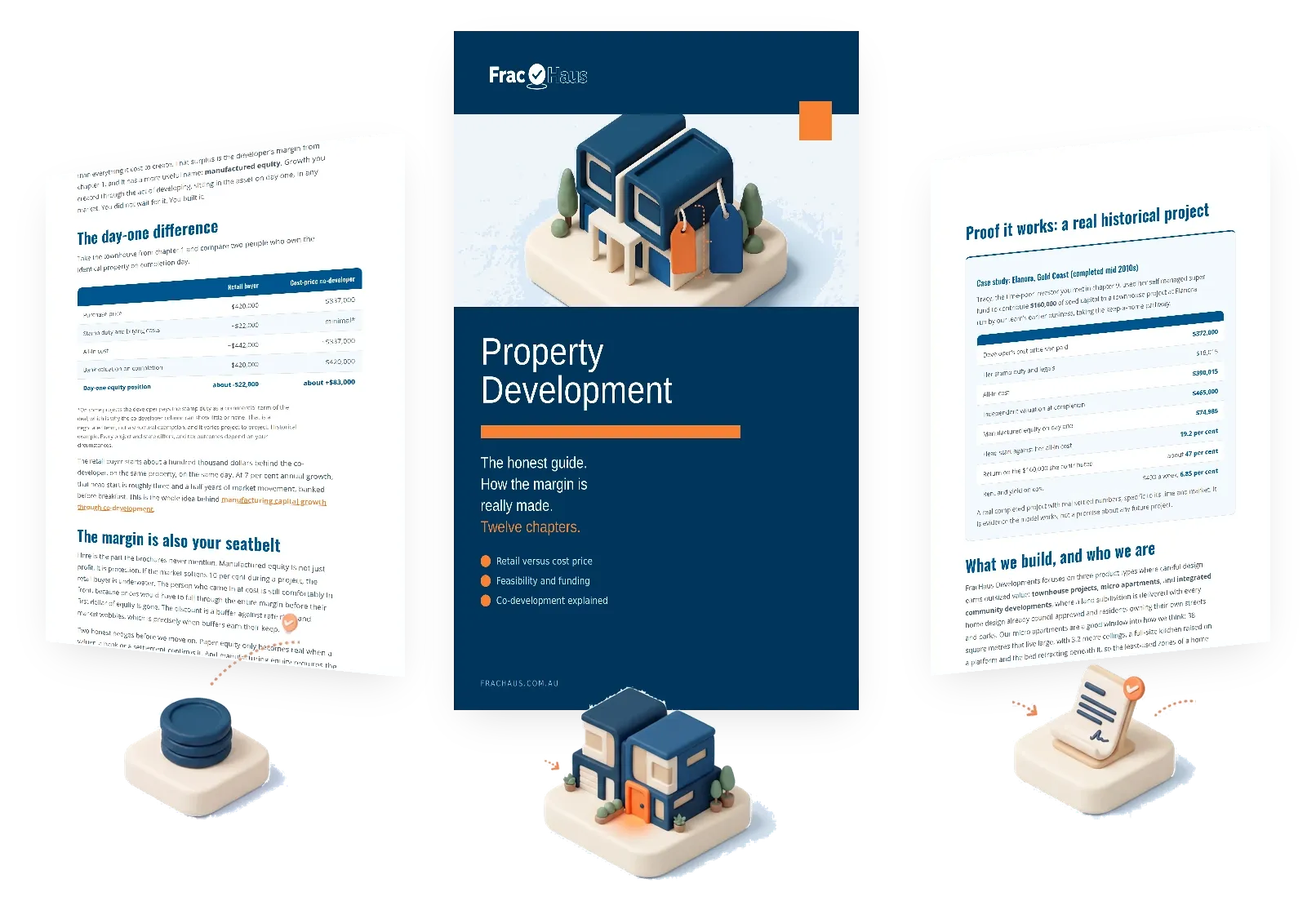
Here is a number worth sitting with for a moment. When a brand-new townhouse sells, somewhere between 15 and 25% of the price the buyer pays was never bricks, land or labour. It was the developer's margin, the marketing, the agent, the glossy render of a couple laughing near a bench. The buyer pays retail. The developer got the same property at cost.
This guide explains that gap. Not as a sales pitch, as an education. Twelve short chapters that walk you through how residential development actually works in Australia: where the profit comes from, the stages a project moves through, the approvals, the funding, the construction, and the very real ways it can go wrong.
Why we wrote it
Two reasons, and we will be upfront about both.
First, we would rather you understand development properly than take our word for anything. When investors join one of our projects, we want them arriving with their eyes open: knowing what a feasibility is, why the margin exists, what a presale does, and exactly where their money sits in the queue. Educated investors ask three sharp questions instead of a thousand anxious ones, and the whole project is better for it.
Second, honestly, it is a filter. By the end of this guide you may conclude that development is a brilliant wealth strategy and also that running one yourself, with your job and your weekends, is not realistic right now. One of our past investors put it best after doing a professional development course: it gave her enough knowledge to know she was better off keeping her day job, and enough knowledge to properly assess a development opportunity when one crossed her desk. That combination is exactly who this guide is for.
Where the margin actually comes from
Start with the thing almost nobody explains. Every new property has two prices. There is the retail price a buyer pays, and there is the cost price it took to create. The distance between them is not luck or a hot market. It is manufactured, on purpose, by the person who did the work of turning a plan and a patch of dirt into finished homes.
Break a retail price into its parts and the picture gets clear fast. Land, construction, professional fees, finance and holding costs, and council contributions make up the cost to create. Sitting on top of all of that is the developer's margin and the cost of selling: agents, marketing, that render. The buyer pays for the lot. The developer, having carried the risk, keeps the top slice.
So what does that mean for you? It means the growth on a development does not depend on waiting a decade for the market to lift. It is created the moment a finished home is worth more than it cost to build, which is the whole idea behind manufactured equity, growth you make on day one rather than hope for over ten years. The full anatomy of those two prices is chapter one, where we pull a retail price apart piece by piece. And if you want to see exactly where in a project that margin is won or lost, the blog goes deep in the seven stages of a small residential development, and where the margin hides.
How a development actually unfolds
People picture a developer in a hard hat swinging a hammer. The reality is closer to a project manager running a two-year relay of specialists, most of the value decided long before a single brick is laid. A small residential project moves through nine stages, from finding and tying up a site, to design and approvals, to funding, to construction, to selling or settling the finished homes.
The uncomfortable truth is that the money is usually made or lost at the front, on the desk, not on the tools. Buy the wrong site or misread the numbers and no amount of good building saves it. Get the site and the feasibility right and the rest is disciplined delivery. We map the whole run in the development journey, nine stages and roughly two years end to end, and the blog walks each stage in order in the seven stages, from site selection to settlement.
The feasibility decides everything
Before anyone digs, the whole project lives or dies in one spreadsheet. A feasibility works backwards. You start with the end value, what the finished dwellings will sell or value at, then subtract every cost to create them and the profit margin you need to justify the risk. Whatever is left is the most you can afford to pay for the land. That figure has a name: the residual land value.
This is the single most useful idea in the whole guide, so it is worth a plain example.
| Line | Amount |
|---|---|
| Gross realisation (what the finished homes are worth) | $4,000,000 |
| Less construction, professional fees and contingency | −$2,300,000 |
| Less finance, holding and selling costs | −$500,000 |
| Less developer's profit margin (about 20%) | −$640,000 |
| Residual land value (the most you can pay for the site) | $560,000 |
Illustrative round numbers only, to show the shape of the calculation. Every site is different.
Here is the discipline that separates developers from optimists. If the site is on the market for more than the residual land value, the deal does not work, however much you love the street. The feasibility, not the location and not the feeling, holds the veto. We take it slowly in the site and the feasibility, the spreadsheet that decides everything before anyone digs, and the blog runs a full worked example in development feasibility 101, running the numbers before you commit.
Approvals: patience is a line item
Once the numbers work, the site has to be allowed to become what the feasibility assumes. That is the approvals stage, and it is where first-timers underestimate both the time and the cost. Design, town planning, council assessment, consultants for traffic, stormwater, bushfire or acoustics, and sometimes a round or two of changes. On a small project this commonly runs four to twelve months, and every month is holding cost quietly eating the margin.
None of it is glamorous, and all of it is where a good developer earns their fee by keeping the process moving. We walk the maze in the approvals stage, councils, consultants and why patience is a line item.
Funding is the real gatekeeper
Now the part that stops almost everyone. Not knowledge. Capital.
A senior lender will typically fund only 60 to 80% of the total development cost, and only once the developer has put their own money in first and lined up enough presales or committed outcomes to prove the finished homes will actually sell. On a $10 million project, that can mean $2 to $3 million of equity has to be found before the bank contributes a cent. This is the wall. You can understand feasibilities perfectly, read a market beautifully, and still never turn a spade, because the deposit and the presales are out of reach.
So what do you do if you do not have three million dollars sitting idle? More than you would think. There are the seven criteria a lender actually assesses, and knowing them tells you whether a deal is fundable before you waste a month on it. There are also creative structures that let projects happen without one person carrying the whole deposit. This is exactly the ground co-development is built on. Go deeper in funding, the real gatekeeper, and why a $10 million project needs $3 million before the bank says hello, then read the blog on the seven factors banks use to fund a development and five creative ways to fund a property development. If you are weighing a crowdfunding deal, we show how to read one properly in comparing development crowdfunding by risk and return.
Rather sit on the funded side than find the deposit yourself?
Join the community →Construction, and then a fork in the road
Construction is the visible, nerve-wracking part, and yet by the time the slab is poured most of the important decisions are already behind you. The job here is control: a sound building contract, disciplined management of variations, and holding the line on cost while the homes come out of the ground. We cover it in construction and delivery, builders, contracts, variations and holding the line on cost.
Then comes the decision that changes the maths. Sell the finished homes and take the margin as cash, or hold one and keep it at cost price so the built-in equity and the stronger yield stay with you. Neither is right for everyone, and the choice depends on the project and on what the investor actually wants. We lay out the fork in completion, sell or hold, and why holding at cost changes the maths.
When to develop, and why timing is not the point
A fair question at this stage is when to start, and the honest answer surprises people. The best time to develop is not when the cycle looks hot. It is when the feasibility works, because a project that only stacks up if prices keep rising is a bet, not a development. The safer approach is to buy for genuine value in a market that is neutral today but tightening underneath, so it is easy to sell or let by the time you complete in a year or two.
That is where the development guide meets our other pillar. The blog makes the case in when is the best time to develop property, and the full method for reading a market sits in where and when to buy residential property, decided by evidence not hope.
The hard truths, before you fall in love with it
Let us agitate the obvious risk, because pretending it away helps no one. Costs blow out. Approvals drag. A builder goes under mid-project. The market you sell into is softer than the one you bought in. Interest eats a margin that looked comfortable on paper. Development rewards the people who respect these risks and manage them, and it punishes the ones who assume it will all go to plan because it did for someone on a podcast.
This is not meant to scare you off. It is meant to make you the kind of person who asks the right questions. We are blunt about it in the hard truths, why most people never develop and the mistakes that catch first-timers. Reading it is how you tell a sober opportunity from a shiny one.
You do not have to become the developer
Here is the resolution the whole guide has been building toward. Everything above is true, and most people reading it will decide, quite sensibly, that running a two-year project around a full-time job is not for them. That does not mean the developer's side of the table is closed to you.
A developer has two problems on every project: they need equity in before the bank will move, and they need committed outcomes to satisfy the lender. Co-development solves both by bringing in a small group of investors as the seed capital. In return, those investors take the developer's side of the economics rather than the retail buyer's. The growth is not something you wait and hope for, it is manufactured by the development, and you can capture it in one of two ways.
Put capital into the development and take a cash return at completion, paid from the profits ahead of the developers' share, without carrying the bank debt or running the build yourself.
Join for this path → See how co-development worksTake a completed home at developer cost price instead of retail. The margin you would have paid becomes manufactured capital growth: instant equity, a boosted rental yield, and a deposit that frees your original capital.
Join for this path → See the cost-price pathEither way, you either acquire a brand new property at a developer's cost price or share in the returns as a "passive" developer. The directors carry the bank debt and co-invest in every deal, so our money sits right beside yours. We explain the model in co-development, the FracHaus way, the two problems every developer has and the door they open for investors, and the mechanics of who gets paid when in how a project is structured, one project, one company, and why investors get paid before we do.
How to read the guide
In order, ideally. The chapters build on each other the way a project does: first the economics, then the process, then the risks, and only then how our co-development model works and how a project is structured. Each chapter ends with a short list of takeaways and a spot where you will find a short video of Michael and Peter talking about their own experience of that stage. Rough, unscripted, from projects they have actually run.
One thing you will not find here: details of any current project. We bring opportunities to a small number of people in our community, rather than listing them publicly. So the examples in this guide are real but historical, and the last chapter tells you how the community works.
The twelve chapters
- 01 Developer cost price: every new property has two prices Retail versus wholesale, and the anatomy of the price you usually pay.
- 02 Manufactured equity Growth you create on day one, versus growth you wait a decade for.
- 03 The property development process, stage by stage Nine stages, two years, and surprisingly few hammer swings by the developer.
- 04 Residual land value: what a site is worth to a developer The spreadsheet that decides everything before anyone digs.
- 05 The development approval maze Councils, consultants, and why patience is a line item.
- 06 Property development equity requirements: the real gatekeeper Why a $10 million project needs $3 million before the bank says hello.
- 07 Construction, delivery and the fixed price building contract Builders, contracts, variations, and holding the line on cost.
- 08 Develop and hold, or sell: the two roads from completion The fork in the road, and why holding at cost changes the maths.
- 09 Property development risks: the hard truths Why most people never develop, and the mistakes that catch first-timers.
- 10 Property co-development: the FracHaus way Two problems every developer has, and the door they open for investors.
- 11 The development SPV structure behind every project One project, one company, and why investors get paid before we do.
- 12 Your next step: the FracHaus community The community, how we introduce projects, and what happens next.
Go deeper: the full story on each part
The chapters give you the shape of development. When you want the detail on a single piece, these are the deep-dives, each one a full read on its own.
- 01 The 7 stages of a small residential development A stage-by-stage walk through a project, and the point in each where the margin is won or lost.
- 02 Development feasibility 101 How a feasibility works, from end value back to what the land is really worth, with a worked example.
- 03 The 7 factors banks use to fund a development The criteria a lender assesses before it says yes, the thresholds they want, and your options if you fall short.
- 04 5 creative ways to fund a property development From manufactured equity and vendor finance to joint ventures and gap funding when you do not have the full deposit.
- 05 Comparing development crowdfunding by risk and return Two checks that tell you what you are really being paid for: your place in the capital stack and the stage of the project.
- 06 When is the best time to develop property? Why the best time to develop is when the feasibility works, not when the cycle peaks.
Where the guide leads
The last three chapters explain the model this business runs on. If you would rather see the two investor pathways set out on their own pages, they are here: investing in property development for a cash return, and manufacturing capital growth at developer cost price for a home held at cost. How FracHaus works covers the process end to end.
Property development: quick answers
How does property development actually make money?
A developer creates a finished dwelling for less than it is worth on completion. The difference between the total cost to create it and its market value is the development margin, and on a new property that margin plus the selling costs and marketing is typically 15 to 25% of the retail price. The margin is the reward for carrying roughly two years of site, approval, funding and construction risk that a retail buyer skips entirely.
How long does a property development take?
A small residential project such as a handful of townhouses typically runs 18 months to 3 years from site research to settlement, across nine stages. Design and development approval alone commonly takes four to twelve months, and construction nine to fourteen months on a small project.
What is a development feasibility?
A feasibility is the spreadsheet that decides whether a project is worth starting. You take the gross realisation (what the finished dwellings will sell or value at), subtract every cost to create them (construction, professional fees, finance, approvals, contingency) and the required profit margin, and what is left is the most you can afford to pay for the land. That last figure is the residual land value. If the asking price for a site is above it, the deal does not work, no matter how much you like the location.
How much money do you need to develop property?
More than most people expect, and capital rather than knowledge is what stops most would-be developers. Senior lenders fund around 60 to 80% of total development cost, so the developer must contribute the rest first. On a $10 million project that can mean $2 to $3 million of equity before the bank contributes anything.
Can you invest in property development without becoming a developer?
Yes. Co-development means a small group of investors provides a project’s seed capital, which also gives the project the committed outcomes a lender needs to see. In exchange those investors take the developer’s side of the economics, either as a cash return paid ahead of the developers, or by keeping a completed home at the developer’s cost price. You co-own real property directly on title. It is not a pooled fund, and the directors carry the bank debt and co-invest in every project.
Is this guide an investment offer?
No. It is education only, and it deliberately contains no current project, price or return. Any investment opportunity is offered later, privately and with full documentation, to a small number of people in our community.
Read it, then sit on the developer's side of the table.
Join the community and tell us which path fits. It costs nothing, there is no obligation, and no specific offer is made until we have spoken personally. We keep each project small and speak to the people in our community first.
Join the community