

Invest in property development for a cash-on-cash return
There are two ways to profit from a development, and this is the one where you never own the house. You put capital into a project, we run it from the site search through to completion, and at the end your capital comes back with a share of the profit the build created. No mortgage in your name, no tenant, no site to run, and a defined finish line rather than an open-ended hold.

Same build, two exits, and this one has no mortgage in it.
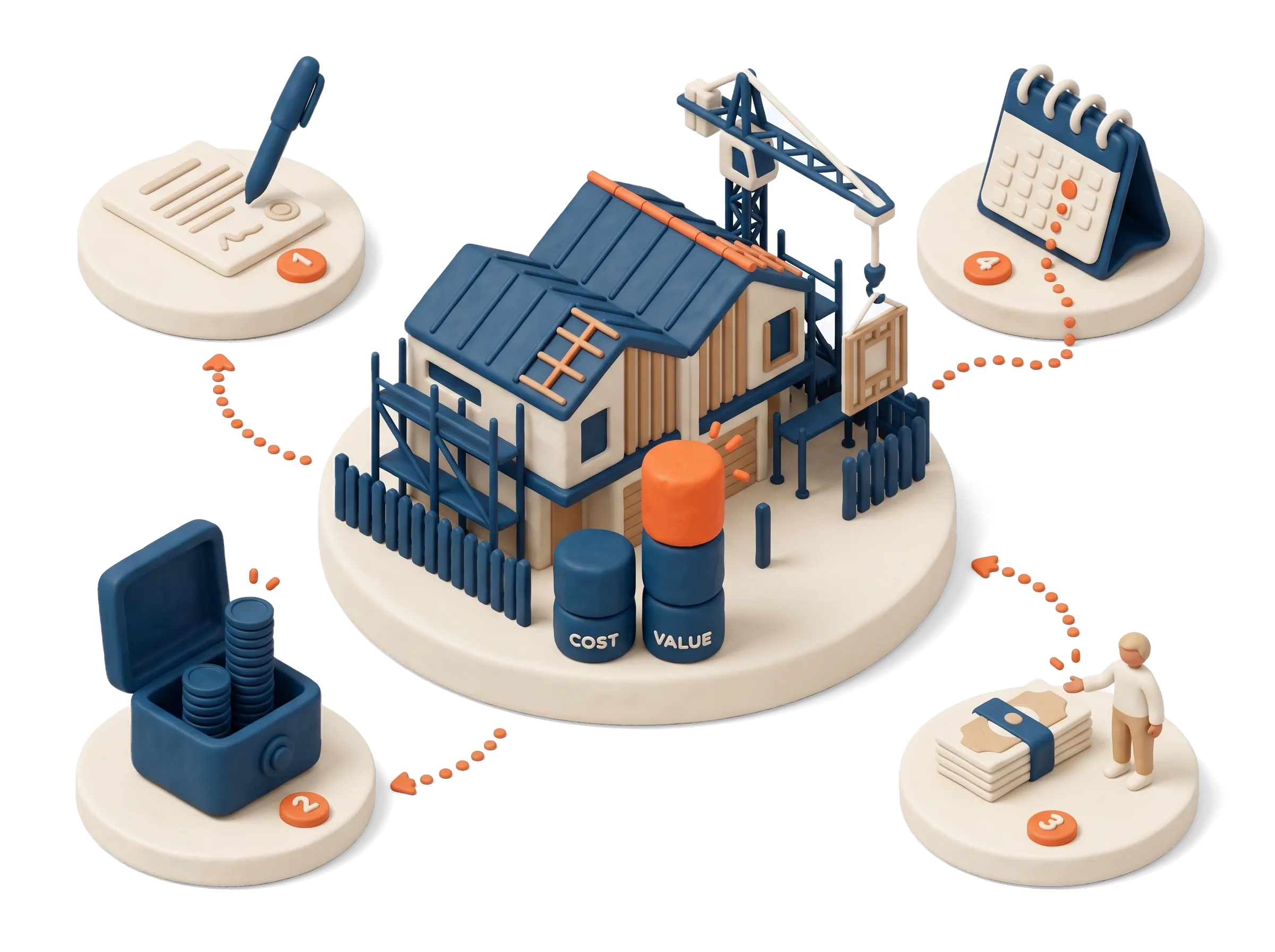
Every project we run creates the same thing: a gap between what it costs to make a home and what that home is worth once it exists. Developers call it the margin, and it is the reason anyone builds anything. The only real question is what you want to do with your share of it.
One answer is to keep a house. You take a finished home at what it cost to create, the margin stays with you as equity, and you hold the asset, the rent and the depreciation. That path needs a mortgage, and it needs you to want a property.
The other answer is the one this page is about. You never take title to anything. Your capital goes in at the start, the project runs, and at completion your money comes back to you with a share of the profit it helped create. No loan application, no valuation, no tenant, no land tax. Just capital in at one end and capital out at the other, on a timeline you can see before you commit.
The developer's margin is the same either way. This is simply the version where you take it as cash and walk away, instead of taking it as a house and taking on a mortgage.
It is not a loan, and the 20% is a ceiling, not a promise.
Most people arrive here assuming one of two things: that they are lending money at a rate, or that a percentage on a website is a number someone owes them. Neither is true, and the difference is the single most important thing to understand before you go any further.
An equity position
Usually a preference share in the project. You are an owner in the project, on the same side of the table as the people running it, not a creditor lending to them.
20% of your capital, from profit
The position carries a right to a preferred return of 20% of what you put in, paid out of the project's profits. That 20% is the most it can earn, however well the project does.
You are paid first
The preferred return is paid ahead of the developers' share of profit. They only earn on the upside once your 20% has been paid. It does not rank ahead of the bank.
Where the money actually goes, in order
- 1The bank
A secured lender is paid first, always. The directors carry that debt, not you.
- 2Your capital
The money you put in is returned before profit is shared out.
- 3Your preferred return
Up to 20% of your capital, paid from profit, ahead of the developers.
- 4The developers
Whatever profit is left after the above. If there is none, they earn nothing on the upside either.
This is the shape of the structure, not a term sheet. The exact terms, the ranking and the documents are specific to each project and are put in front of you in writing before you decide anything.
What happens when a project doesn't go to plan.
A preferred return paid from profit has an obvious implication that a lot of operators skate past. If there is no profit, there is nothing to pay it from. Here is the full range, stated plainly, because you should judge this on the bad outcomes and not just the good ones.
Capital back, plus the full 20%
The development makes enough profit to clear your capital and your preferred return in full. You receive what you put in plus 20% of it, and the developers take what is left.
Capital back, plus part of the 20%
There is a profit, but not enough to pay the preferred return in full. You are still paid ahead of the developers, so you receive your capital and whatever portion of the 20% the profit covers.
Capital back, and no return
The project completes without a profit. There is nothing to pay a preferred return from, so you get your capital back and nothing more. Your money was tied up for the duration for no gain.
You can lose capital
A build that runs badly over, a market that turns, or a sale that lands below cost can mean the equity does not come back whole. Equity ranks behind the bank. This is a real risk, not a formality, and it is why we say only invest capital you can afford to have at risk.
Your capital is also illiquid for the life of the project. There is no market to sell the position into and no early exit, so a four-year project means four years.
Four steps, and the evidence comes first.
We prove the demand
Every project starts with our own supply-and-demand research. We only proceed where the data says the demand for that home, in that location, is real.
We stress-test the feasibility
Land, build cost, timelines and end value are modelled and stress-tested. The profit has to survive on paper, with room to spare, before anything is committed in the ground.
You see the numbers, then decide
You get the feasibility and the structure in writing, not a brochure. If it stacks up for you, your capital goes into that specific project.
We build, then you are paid out
We deliver the development and sell the homes. Your capital is returned and the preferred return is paid from the profit, ahead of the developers' share.
A return that comes from building, not from timing.
Not dependent on the cycle
The profit comes from the development margin, created by building the right home in the right place. Rates and sentiment matter far less than they do for a retail buyer waiting on growth.
Evidence before commitment
Nothing proceeds on a hunch. The demand is modelled and the feasibility is tested first, and you see both. It is the same discipline our data brings to the wider market.
Capital, not a second mortgage
You invest capital into a project rather than carrying a seven-figure loan, the land tax and the holding costs alone. The directors carry the bank debt.
Our money sits beside yours
The directors co-invest in every project, and they are paid on the upside only after your preferred return has been paid. Site selection, planning and delivery are ours to manage.
What earlier investors received, and what changed since.
Investors in projects Michael Fuller ran at a previous company received cash-on-cash returns well above 20%, and those reviews are on this site in full. You should read them with one thing firmly in mind.
Those projects ran on an uncapped equity structure
Investors took an open-ended share of the profit, so a project that outperformed paid out accordingly. Figures of 42%, 49% and 57% came from that arrangement. It is not what we offer now. Our projects from here are structured with a preferred return capped at 20% of the capital invested, which means those past outcomes cannot be repeated under the current structure and should not be read as an indication of what to expect.
We would rather say that plainly than let a good number do work it has not earned. Past results are individual outcomes that depended on the specific property, location, costs and circumstances. They are history, not a forecast, and not a promise of future performance.
A developer's 57% return on my cash without all the work. Everything ran smoothly.
 Read all the reviews
 Want the numbers on a real project?
We don't advertise specific projects on this website. When you join the community, we make contact, get to know your goals, and, if it fits, walk you through a live opportunity in person, with the feasibility and the structure in writing.
Frequently asked questions
Is this a loan to the developer?
No, and the distinction matters more than almost anything else on this page. A loan pays interest whether the project makes money or not, and a lender ranks as a creditor. Here you take an equity position in the project, usually a preference share, which is paid out of profit. If the project makes no profit there is no return to pay. You are on the ownership side of the deal, not the lending side, which is exactly why the upside is a share of what the development creates rather than an interest rate.
So is the return fixed?
No. The 20% is a cap, not a promise. Our projects are structured so the capital invested has a right to a preferred return of 20% of what you put in, paid ahead of the developers' share, and that 20% is the most that position can earn no matter how well the project does. But it is paid from profits. If the project makes enough profit, the full 20% is paid. If it makes some, you may receive part of it. If it makes none, you may receive only your capital back, and in a project that goes badly you can get back less than you put in.
What does "preference" actually get me?
Ranking. The preferred return is paid before the developers take their share of the profit, so the people running the project only get paid on the upside after the investor capital has been paid its 20%. It does not rank ahead of the bank, which is a secured lender and is always paid first. It is a queue position within the equity, not a guarantee.
Why cap the return at 20%?
Because a defined number is easier to judge than a projection. A capped preferred return tells you what the position can earn before you commit, and it puts the developers' incentive where it should be, which is on delivering a profit big enough to clear your 20% first. Projects run on different timelines, so a four-year project and an eighteen-month one target the same 20% of capital rather than the same annual rate. Judge it as a return on the money, not a rate per year.
How long does my capital stay in?
For the life of the project, which depends entirely on the project. A small residential development might run eighteen months, and one with a complicated approval or a staged build can run three or four years. Your capital is not liquid during that time. There is no market to sell your position into and no early exit, so only capital you can genuinely leave alone belongs here.
How is this different from buying a rental property?
A rental needs a mortgage in your name, produces rent, costs you holding expenses, and relies on the market to lift its value over years. This has no loan, no tenant, no land tax and no property, and it ends on a defined date with a cash return. The trade is real: you give up the asset, the rent, the depreciation and any long-run growth, and in exchange you skip the debt and the decade. If you would rather keep the house, that is the other path.
Do I need to be a builder or know development?
No. You provide capital and we run the development, from site selection through to completion. Our role is the data, the feasibility and the delivery. Yours is the investment decision, which is why we put the feasibility in front of you rather than a brochure.
Is this an investment offer?
No. This page is general information about how the model is structured. If it looks like a fit, join the community and we will make contact. Any opportunity is offered privately to a limited number of eligible investors, and only after we have spoken.
Ready when you are.
Join the community and we will be in touch. Projects are shared privately with members, a few at a time, once we have spoken.
Join the community