Residual land value: what a site is worth to a developer
The spreadsheet that decides everything before anyone digs.
There is an old property saying that you make your money when you buy. Like most old sayings it is about 80% true. What you actually do when you buy is set the ceiling on your profit. Pay the right price for the right site and everything after is execution. Pay too much and no amount of brilliant building gets the margin back.
The instrument that decides all of this is the feasibility, or feaso if you want to sound like you have done one. It is a spreadsheet whose entire job is to say no. A good developer runs dozens of them for every project that proceeds, and thanks the spreadsheet for every rejection.
Residual land value: what a feasibility actually contains
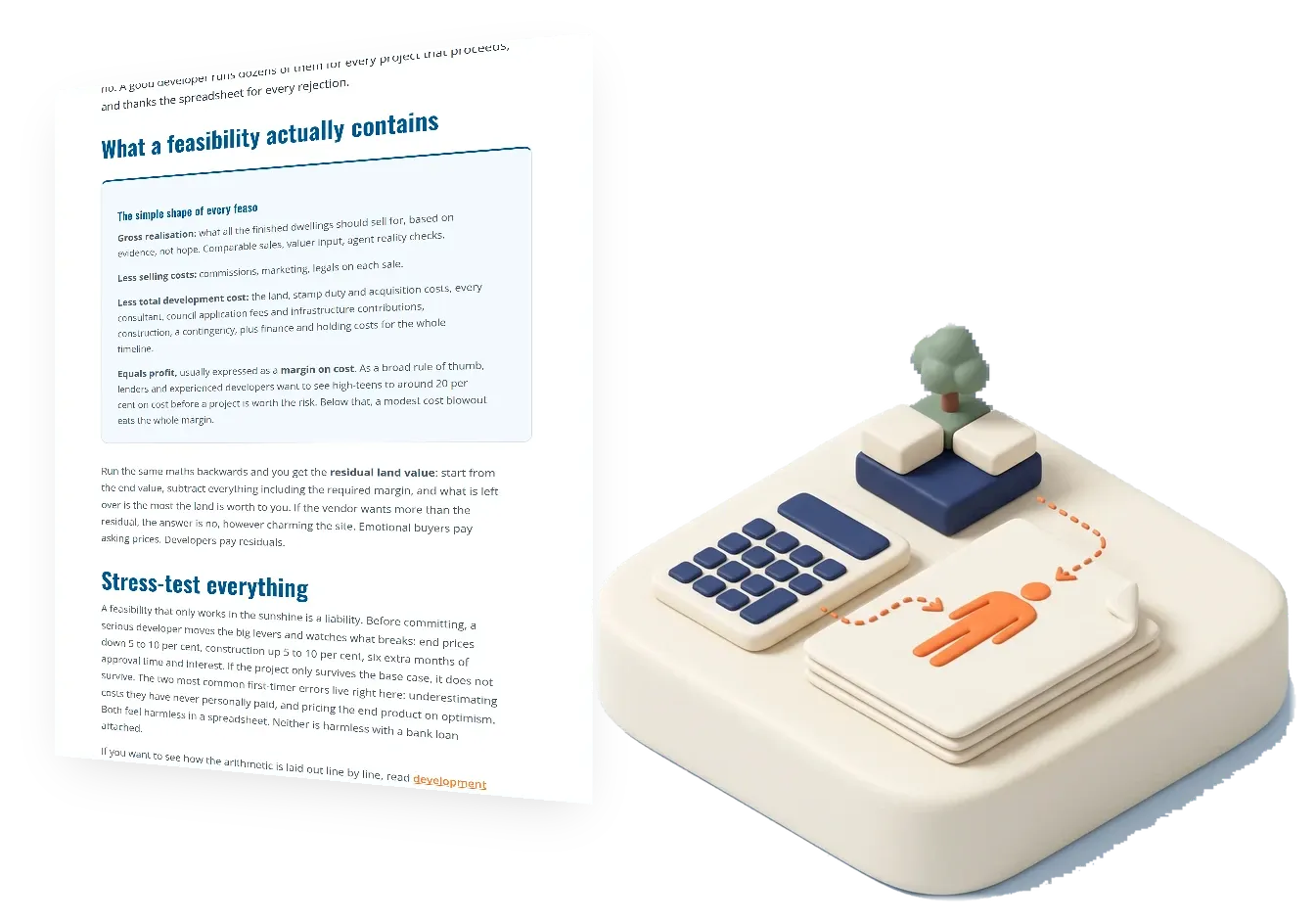
Run the same maths backwards and you get the residual land value: start from the end value, subtract everything including the required margin, and what is left over is the most the land is worth to you. If the vendor wants more than the residual, the answer is no, however charming the site. Emotional buyers pay asking prices. Developers pay residuals.
The development feasibility stress test: move every number
A feasibility that only works in the sunshine is a liability. Before committing, a serious developer moves the big levers and watches what breaks: end prices down 5 to 10%, construction up 5 to 10%, six extra months of approval time and interest. If the project only survives the base case, it does not survive. The two most common first-timer errors live right here: underestimating costs they have never personally paid, and pricing the end product on optimism. Both feel harmless in a spreadsheet. Neither is harmless with a bank loan attached.
If you want to see how the arithmetic is laid out line by line, read development feasibility 101. And because a feasibility is only as good as the demand behind its end values, it pays to understand where and when to buy residential property before you trust any gross realisation figure. When you are ready to run these numbers against real blocks of land, how we find development sites shows the search process end to end.
Questions people ask about this
What is residual land value?
Residual land value is the most a development site is worth to a developer. You start from the gross realisation (what the finished dwellings should sell for), subtract selling costs, subtract every development cost, and subtract the margin the project must earn to be worth the risk. Whatever is left is the maximum you can pay for the land. If the vendor wants more than the residual, the answer is no.
What margin does a property development need?
As a broad rule of thumb, lenders and experienced developers want to see high-teens to around 20% margin on cost before a small residential project is worth the risk. Below that, a modest cost blowout can eat the entire margin.
How do you stress-test a development feasibility?
Move the big levers and watch what breaks. Take end prices down 5 to 10%, put construction costs up 5 to 10%, and add six extra months of approval time and the interest that comes with it. If the project only survives the base case, it does not survive.
Your next step
Want to see a real feasibility with real numbers?
Community members receive the full feasibility for any project they are personally offered. That is the standard, not the exception.