

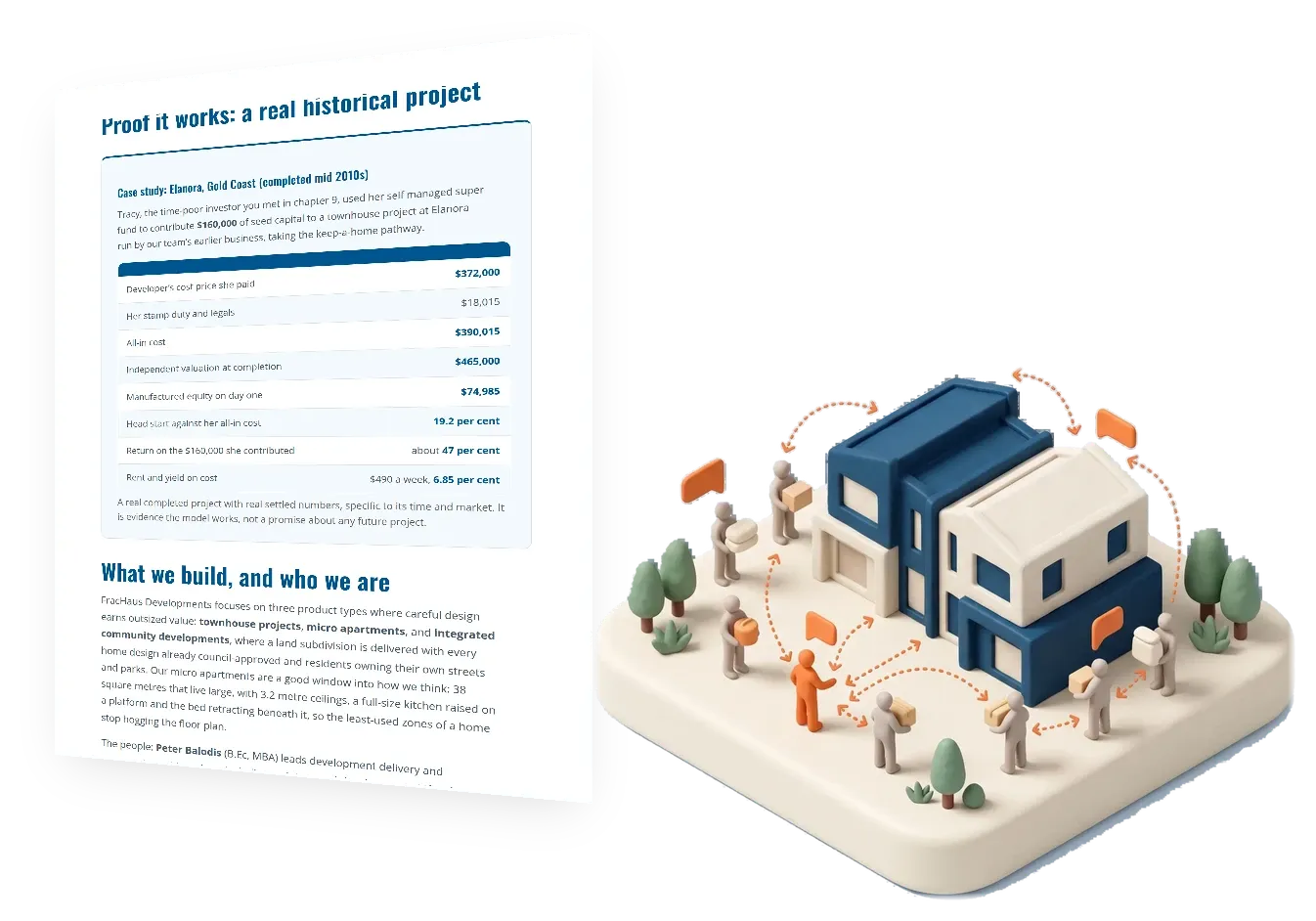
Put those side by side and the model almost writes itself. Co-development is a small group of investors providing a project’s seed capital, and in doing so, giving the project the committed outcomes a lender wants to see. The bank funds construction. The project proceeds. The developer earns their margin on the dwellings sold at retail. And the co-investors, who solved the two problems, share the developer’s side of the economics instead of paying the retail side. Nobody is doing anybody a favour. It is simply a better trade for both parties than the retail machine.
Two pathways: cash return, or the developer cost price pathway
Pathway one: the cash return. You contribute capital to the project, and at completion you receive your capital back plus a preferred return, paid ahead of any profit to us. You never own a dwelling, never arrange a loan, never meet a tenant. Chapter 11 shows exactly how that priority works, and investing in property development for a cash return sets out the approach in full.
Pathway two: keep a home at cost price. Your contribution becomes part of the purchase of a specific dwelling in the project, which you settle on completion at the developer’s cost price. The manufactured equity from chapter 2 is yours, sitting in the asset from day one, with the hold-at-cost yield mathematics from chapter 8. That pathway has its own page: acquiring property at developer cost price.
Proof property co-development works: a real historical project
What we build, and who we are
FracHaus Developments focuses on three product types where careful design earns outsized value: townhouse projects, micro apartments, and integrated community developments, where a land subdivision is delivered with every home design already council-approved and residents owning their own streets and parks. Our micro apartments are a good window into how we think: 38 square metres that live large, with 3.2 metre ceilings, a full-size kitchen raised on a platform and the bed retracting beneath it, so the least-used zones of a home stop hogging the floor plan. Where micro apartments sit among the other small-home types, and how small each state lets a home be, is in our guide to micro housing in Australia.
The people: Peter Balodis (B.Ec, MBA) leads development delivery and construction, with projects including an integrated development at Kensington he will walk you through on camera. Michael Fuller leads capital, data and investor relations, with a career spanning global credit data, the Boomscore suburb research platform, and the earlier co-development projects this guide draws its case studies from. There is more on both of us on the about page, and how FracHaus works sets out the process end to end.