

One project, one company: the development SPV structure
Each FracHaus project is owned by its own special purpose vehicle, an SPV: a company created for that project and nothing else. Your investment relates to one identified project with its own feasibility, its own bank facility and its own accounts. It is not a fund, and your money is not mixed with other projects. If you invest in the Smith Street project, you hold shares in the Smith Street company, full stop. Ring-fencing also works in reverse: one project’s issues cannot reach into another project’s assets.
Preference shares in a property development: the queue, drawn honestly
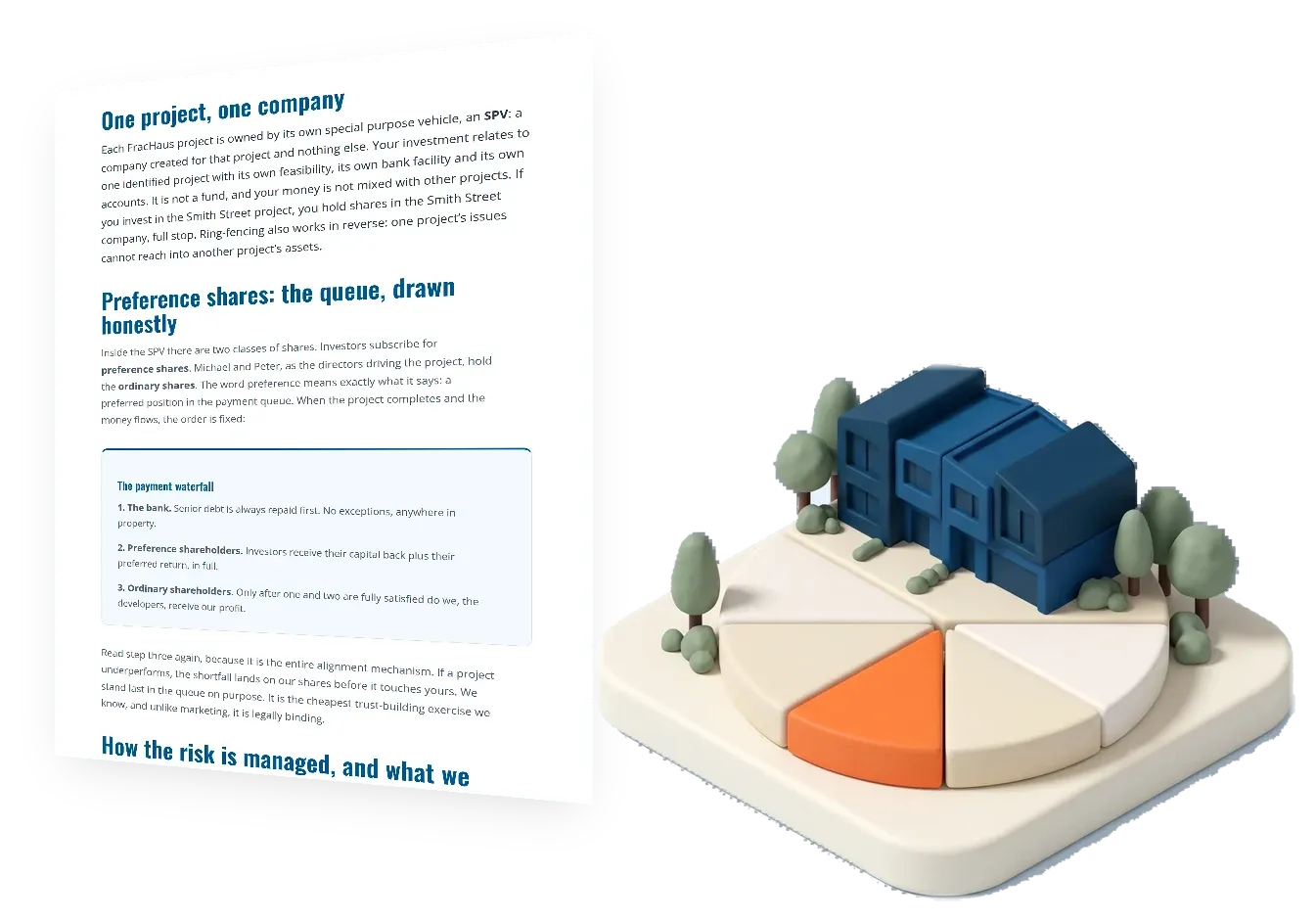
Inside the SPV there are two classes of shares. Investors subscribe for preference shares. Michael and Peter, as the directors driving the project, hold the ordinary shares. The word preference means exactly what it says: a preferred position in the payment queue. When the project completes and the money flows, the order is fixed:
Read step three again, because it is the entire alignment mechanism. If a project underperforms, the shortfall lands on our shares before it touches yours. We stand last in the queue on purpose. It is the cheapest trust-building exercise we know, and unlike marketing, it is legally binding.
How the risk is managed, and what we cannot promise
Everything from chapter 9 applies inside our projects too, managed the professional way: conservative feasibilities stress-tested before we commit, sites bought at residual value or not at all, fixed-price building contracts with vetted builders, genuine contingencies, and gearing kept deliberately below the maximum a lender would allow.
What we cannot do, and will never claim to do, is remove market risk or guarantee a return. The margin is a buffer, the structure is an alignment, and the waterfall is a queue. None of them repeals the property cycle. Anyone who tells you otherwise is selling something, and it is not education.
Why we keep the community small
We deliberately work with a small number of investors on each project, no more than 20 in any year, rather than opening projects to the public. We would rather do a few things properly, with people we have taken the time to know. It is why this guide teaches with historical examples instead of promoting live projects, and why each project involves only a handful of investors who receive full documentation and time for their own due diligence. The community is simply how we get to know the people we work with, honestly and in the open. Our full position is set out in the important disclosures.