Developer cost price: every new property has two prices
Retail versus wholesale, and the anatomy of the price you usually pay.
Walk through any display suite and you will be quoted one price: the retail price. It is printed on the brochure and defended by a very friendly person with a lanyard. What you will never see printed is the other price: the wholesale price, what the property actually cost the developer to create. In the industry that second number is called the developer's cost price, and the gap between retail and wholesale is where this whole guide begins.
Explainer 02 · 7:23
Prefer to watch first? This explainer walks through the two prices, and the chapter below takes each one apart.
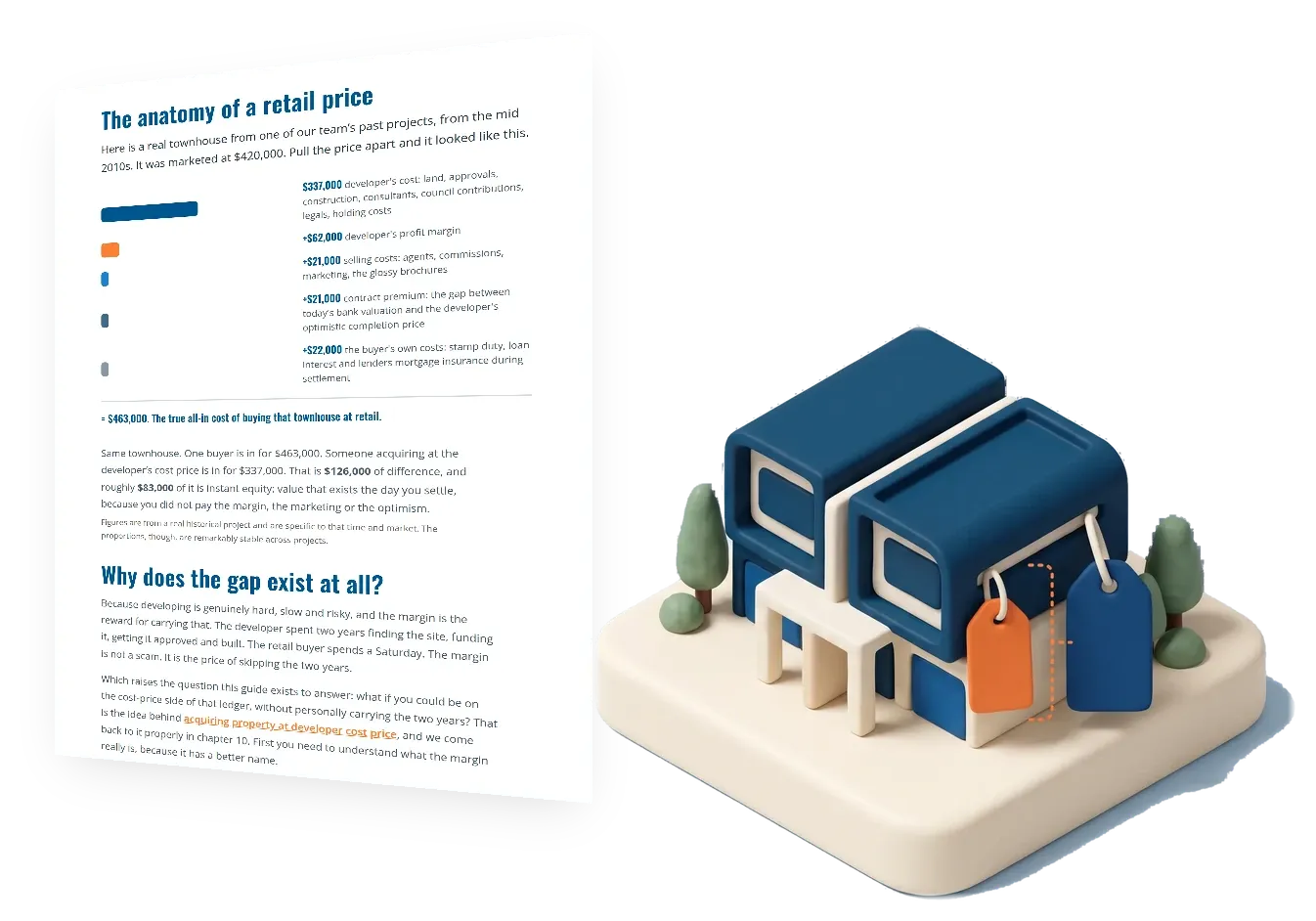
Here is a real townhouse from one of our team’s past projects, from the mid 2010s. It was marketed at $420,000. Pull the price apart and it looked like this.
+$21,000 selling costs: agents, commissions, marketing, the glossy brochures
+$21,000 contract premium: the gap between today's bank valuation and the developer's optimistic completion price
+$22,000 the buyer's own costs: stamp duty, loan interest and lenders mortgage insurance during settlement
= $463,000. The true all-in cost of buying that townhouse at retail.
Same townhouse. One buyer is in for $463,000. Someone acquiring at the developer’s cost price is in for $337,000. That is $126,000 of difference, and roughly $83,000 of it is instant equity: value that exists the day you settle, because you did not pay the margin, the marketing or the optimism.
Figures are from a real historical project and are specific to that time and market. The proportions, though, are remarkably stable across projects.
Why does the developer cost price gap exist at all?
Because developing is genuinely hard, slow and risky, and the margin is the reward for carrying that. The developer spent two years finding the site, funding it, getting it approved and built. The retail buyer spends a Saturday. The margin is not a scam. It is the price of skipping the two years.
Which raises the question this guide exists to answer: what if you could be on the cost-price side of that ledger, without personally carrying the two years? That is the idea behind acquiring property at developer cost price, and we come back to it properly in chapter 10. First you need to understand what the margin really is, because it has a better name.
Questions people ask about this
What is a developer's cost price?
The developer's cost price is the total amount it costs a developer to create a finished dwelling: the land, stamp duty and acquisition costs, consultants, council fees and infrastructure contributions, construction, contingency, and finance and holding costs across the whole project timeline. It excludes the developer's profit margin, the selling and marketing costs, and the contract premium that make up a retail price.
How much cheaper is developer cost price than retail?
The gap between the developer's cost price and the retail price is typically 15 to 25% of the retail price. On a real historical townhouse marketed at $420,000, the developer's cost price was $337,000, and once a retail buyer's own stamp duty, loan interest and lenders mortgage insurance were added, their true all-in cost was $463,000.
Why does the gap between retail and cost price exist?
Because developing is hard, slow and risky, and the margin is the reward for carrying that risk. The developer spends roughly two years finding the site, funding it, getting it approved and building it. The retail buyer spends a Saturday. The margin is the price of skipping the two years.
Your next step
Want to be on the cost-price side of the ledger?
The community is how we introduce projects, as personal offers, to a small group of educated investors. No obligation and no spam.