

Micro housing
Granny Flat Cost in Australia (2026): The Quote, the Extras and the Tax Catch
TL;DR: In 2026 a granny flat costs about $110,000 to $160,000 for one bedroom and $140,000 to $210,000 for two, on builders' and cost guides' own figures. Site works, connections, approvals and council charges can add $45,000 or more to the quote. And from 1 July 2027 the government's own explainer says a granny flat beside an established home is not a new build for negative gearing.
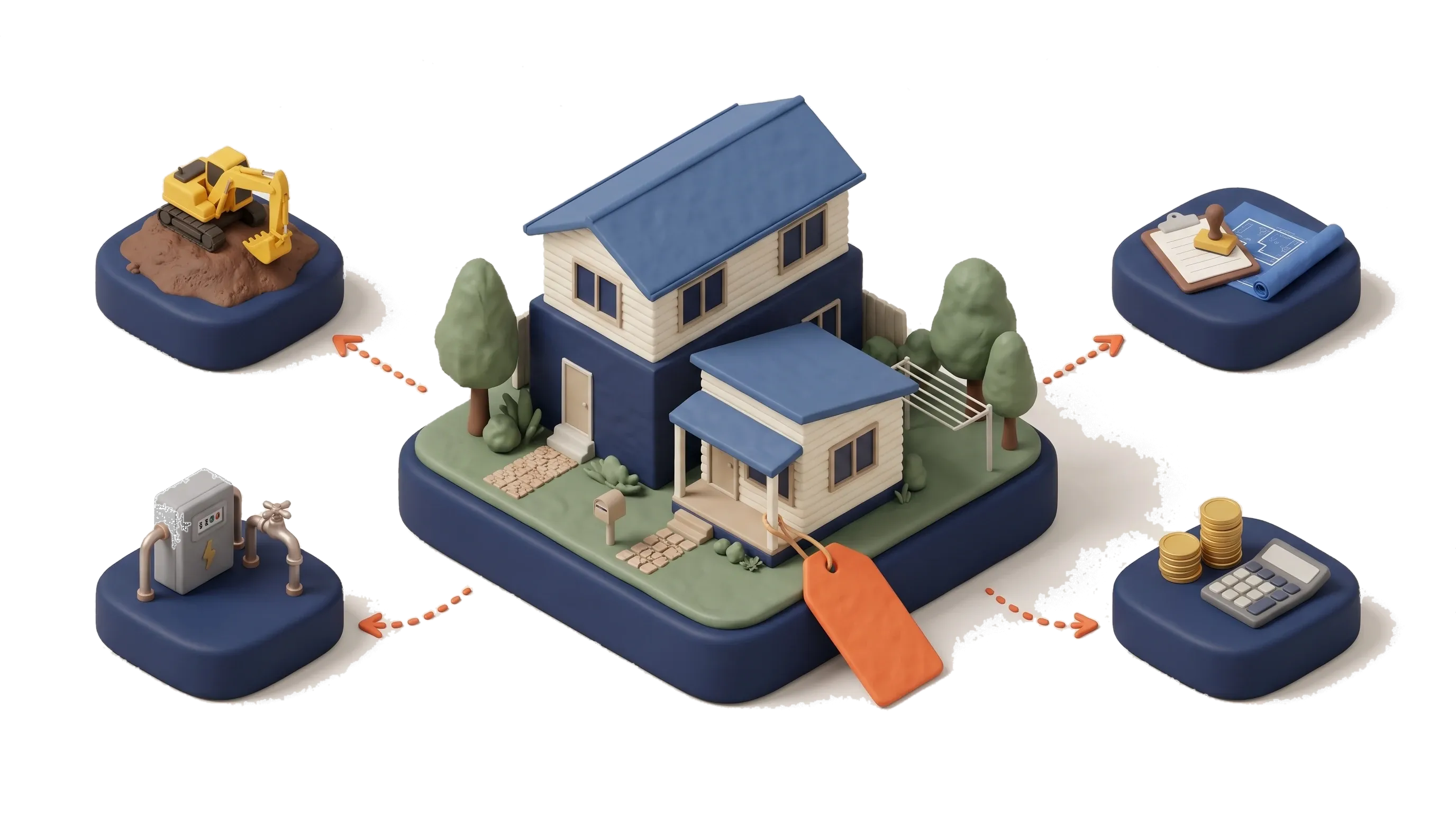

Have you been quoted a granny flat cost and wondered what the final bill will really be?
Do you know which costs sit outside the builder’s contract, and which of them your council sets?
And what if the tax rules that start in July 2027 treat a granny flat differently from every other new home?
They do. Ahead: what builders are quoting in 2026, the all-in sum once the extras are added, the approval rules state by state (two of them new this spring), the tax line that runs through your backyard, what a granny flat adds and returns, and where one fits.
Plenty of people are asking. Builders surveyed by the Housing Industry Association expected to build 10 times more granny flats in 2026 than they did in 2022, and NAB says its renovation lending jumped 21 per cent in 2025.
Granny flat cost in Australia: what builders quote in 2026
Most quotes land between $110,000 and $210,000, depending on bedrooms. There is no official average, so every figure below is a builder’s price list or a cost guide’s estimate, named and dated.
| Where | One bedroom | Two bedrooms, about 60 m² | Whose figure |
|---|---|---|---|
| National | $110,000 to $160,000 | $140,000 to $210,000 | What’s The Damage, cost guide, Nov 2026, turnkey |
| Sydney and NSW | $120,000 to $180,000 | $150,000 to $220,000 | The Quote Yard, Aug 2026, build only |
| Melbourne | $120,000 to $180,000 | $160,000 to $260,000 | The Quote Yard, Apr 2026, custom build only |
| South East Queensland | From $130,900 | $163,800 to $195,100 | Dixon Homes price list, June 2026, fixed price |
| Perth | Basic from $120,000 | Mid-range $150,000 to $180,000 | Granny Flats by Hallmark, 2026, by finish not bedrooms |
Sources: What’s The Damage, The Quote Yard for NSW and Victoria, Dixon Homes and Granny Flats by Hallmark.
Three things to know before you trust any table like this, ours included.
- The low numbers are older or smaller. Canstar still quotes Hipages at $80,000 to $160,000, and prefab one-bedroom units start around $80,000 in The Quote Yard’s Victorian guide.
- City-by-city tables are often one number repeated. One popular guide shows the identical range for seven capitals. That is a national model with a city’s name on it, not local data. We could not find a published Adelaide builder price to check against at all.
- “Build only” means what it says. Two of the five rows above stop at the structure, and a third does not say what is included.
Which brings us to the part of the bill nobody leads with.
How much does it cost to build a granny flat, all in?
More than the quote, and in our worked example about $47,000 more. It is built only from published figures: a 60 m², two-bedroom design at a builder’s from-price, on a block in Newcastle.
- Driveway, paths and fencing The low end $5,000
- Approvals and certification Plans, certifier, fees $5,000
- Council contribution Newcastle, secondary dwelling $12,421
- Site works and connections Sewer, water, power, levelling $25,000
- Build contract Two bedrooms, 60 m², a published from-price $163,800
All in $211,221
That is $211,221, or 29 per cent more than the number on the quote. The extras are not padding. They are the parts no builder can price until someone has looked at your block.
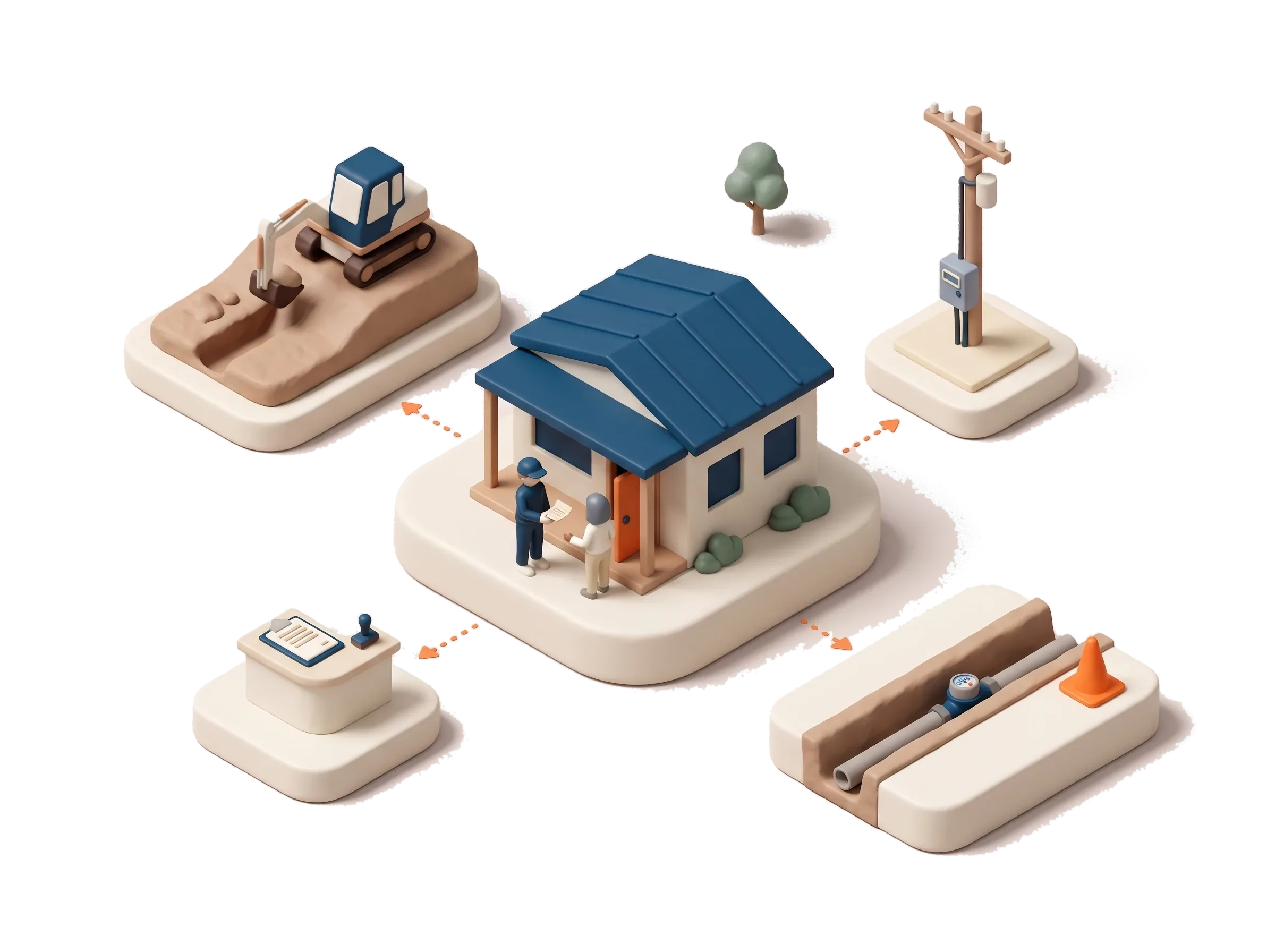
- Site works and connections. The Quote Yard puts NSW service connections at $5,000 to $25,000 “depending on distance”, and site costs at $15,000 to $60,000. A flat at the back of a long block costs more to plumb than one beside the house.
- Council contributions. This is the one your council sets. Newcastle charges $12,420.65 for a secondary dwelling. Blacktown’s Mount Druitt plan charges $5,820 for two bedrooms. Victoria exempts small second homes from development contributions altogether, and Noosa dropped its charge in July 2025, saving owners “on average around $7000”.
- Approvals. $3,000 to $8,000 in NSW on The Quote Yard’s figures, more where a planning permit is needed.
So ask every builder the same question: what is not in this price? Then ring the council and ask what it charges for a secondary dwelling. Two phone calls, and the quote becomes a budget.
Do you need council approval? The rules, state by state
Yes, everywhere, in the sense that a granny flat always needs building approval. What differs is the size limit and whether you also need planning permission. Two states changed their limits this spring.
| State | Size limit | Planning position | Renting |
|---|---|---|---|
| NSW | 60 m² | Fast-tracked on lots of 450 m² or more; cannot be subdivided off | Check your council |
| Victoria | 80 m² since 15 Oct 2026 (was 60) | No planning permit on most lots of 300 m² or more; building permit still needed | Anyone |
| Queensland | Set by each council | Building approval, plus council rules | Anyone since 26 Sep 2022 |
| WA | 70 m² (90 m² proposed) | No planning approval on any lot size since 10 Apr 2024, if it meets the codes | Allowed |
| SA | 70 m² (was 60) | Check PlanSA for your zone | Anyone since Nov 2023 |
| Tasmania | 90 m² from 25 Nov 2026 (was 60) | Building and plumbing approval | Check the scheme |
| ACT | 90 m² | Development application; block over 500 m² | Check the lease |
Sources: NSW Planning and the Housing SEPP, Victorian planning, Planning Queensland, the WA Government’s 2024 changes and 2026 proposal, South Australia’s size and rental changes, Tasmania’s State Planning Office and ACT Planning.
The direction is the same everywhere: bigger, and with less paperwork. A bigger limit is not a free upgrade, though. Twenty more square metres is twenty more square metres to pay for.
The tax line that runs through your backyard
Rent a granny flat to a tenant and four things follow. The first three are old law. The fourth is new, and it is the one most cost guides have not caught up with.

- The rent is income. You declare it, and you can claim the costs of earning it. For the building itself, the ATO says the capital works deduction is “generally 2.5% or 4% per year”.
- Your home stops being fully tax-free. The ATO is direct about it: “You’re not entitled to the full main residence exemption from CGT if you rent out part of your home or run a business from home.” When you sell, the share of the gain that matches the rented floor area, for the time it was rented, is taxable. Get a market valuation when the first tenant moves in.
- The “granny flat exemption” is not about tenants. The ATO’s granny flat arrangement rule covers a written agreement giving an older person, or a person with a disability, the right to live in a property for life. Charge market rent and it does not apply.
- From 1 July 2027, a granny flat is not a “new build”. Negative gearing will be limited to new builds, and the budget’s own tax explainer lists, under what is not eligible, “a granny flat built adjacent to an established property that is not eligible for negative gearing.”
That fourth point needs unpacking, because it cuts both ways. The explanatory memorandum to the bill now before Parliament says the granny flat takes the tax treatment of the house it sits behind. If you held that property before 7:30pm on 12 May 2026, it can still be negatively geared, and “the granny flat can be negatively geared too”. If you bought the property after that, the losses on both are quarantined.
What does qualify is a second home on its own title. That is a subdivision, not a granny flat, and it comes with its own bill, which we set out in what it costs to subdivide land. The full new-build test is in what counts as a new build under the 2027 rules.
The wording could still shift before the bill passes, and none of this is tax advice. It is a reason to see your accountant before you sign a build contract, not after.
Do granny flats add value, and what do they return?
Probably yes on value, though the best-known figure is softer than it sounds. In October 2023, CoreLogic, Archistar and Blackfort counted 655,792 homes across Sydney, Melbourne and Brisbane with room for a two-bedroom granny flat. Their press release said one “could add more than 30% to the value of the existing dwelling”. The report itself carries no uplift figure, and one of its three authors is a lender. Treat 30 per cent as a claim, not a valuation.
The return is easier to test, because it is arithmetic. Canstar and other cost guides put rents at $350 to $850 a week depending on the city, without a data source behind the range. Against the $211,221 worked example above:
| Weekly rent | Rent a year | Gross return on the build cost |
|---|---|---|
| $400 | $20,800 | 9.8% |
| $500 | $26,000 | 12.3% |
| $600 | $31,200 | 14.8% |
Those look generous, and there is a plain reason: the land is not in the sum, because you already own it. They are also gross figures, before vacancies, rates, insurance, repairs, interest and tax, and they are our arithmetic, not a forecast.
There is one more catch, and it matters most. A granny flat sits on the same title as the house. You can rent it, but you cannot sell it on its own, so the money goes in as cash and comes out only as rent or as a better price for the whole property.
Where a granny flat fits, and where it doesn’t
A granny flat is the small home that makes sense when you already have the land.
It fits when you own the block and plan to keep it, the lot meets your state’s rules, the house was yours before budget night 2026, and the rent matters more to you than the resale. It is also the simplest way to keep family close without anyone giving up their own front door.
It fits less well as a pure investment bought from scratch. You cannot sell it separately, it draws a tax line through your home, and from July 2027 it carries none of the new-build treatment that a home on its own title does.
That last point is where our own work sits. A granny flat, a micro apartment and a small-lot home are all answers to the same question, which is how to fit a good home onto less land in a place people want to live. We set the whole family side by side in our guide to micro housing in Australia. The difference is the title. Our own UrbanHaus design is 41.36 m², smaller than any granny flat limit in the country, but it is designed as a home on its own title.
And if the appeal of a granny flat is that you are building at cost instead of buying at retail, that idea is not limited to backyards. It is the whole case for buying a new home at the developer’s cost price.
General information only. Nothing here is financial, credit or tax advice, nor an offer of any financial product. Costs, planning rules and tax law change, and yours depend on your block, your council and your circumstances. Speak with your own licensed adviser before acting.
Frequently asked questions
What is the cheapest way to build a granny flat in Australia?
A prefabricated or modular unit is usually the lowest quote. The Quote Yard's 2026 Victorian guide puts a prefab one-bedroom at $80,000 to $130,000 against $120,000 to $180,000 for a custom build, for construction only. The catch is that site works, service connections and approvals cost much the same either way, so compare all-in totals, not the price of the box.
How big can a granny flat be in Australia?
It depends on the state. New South Wales allows 60 square metres, Victoria 80 square metres since 15 October 2026, Western Australia and South Australia 70 square metres, and Tasmania and the ACT 90 square metres, with Tasmania's limit starting on 25 November 2026. Queensland leaves the size to each council. Local rules on setbacks, lot size and overlays still apply.
Can I rent my granny flat to anyone?
In most states, yes. Queensland removed its restrictions on who can live in a secondary dwelling on 26 September 2022, South Australia made it lawful to rent a granny flat to anyone in November 2023, Victoria places no restriction on who can live in one, and Western Australia's exemption covers rental properties. Renting can bring extra building requirements, such as fire separation, so check with your council or certifier first.
Can a granny flat be sold separately from the house?
Generally no. A granny flat sits on the same title as the main house, and the New South Wales planning department says plainly that a lot with a secondary dwelling cannot be subdivided. Victoria's small second home rules carry the same condition. To sell a second home on its own you need a subdivision and a separately titled dwelling, which is a different project with different costs.
Can I negatively gear a granny flat after 1 July 2027?
Only if the main property can be. The federal budget's tax explainer lists a granny flat built beside an established property as not an eligible new build, and the explanatory memorandum to the bill now before Parliament says the granny flat takes the tax treatment of the house it sits behind. If that property was held before 7:30pm on 12 May 2026 it keeps negative gearing; if it was bought later, the losses are quarantined. This is general information, not tax advice.
Sources
- Tax explainers: negative gearing and capital gains tax (Budget 2026-27) — Australian Government, budget.gov.au, accessed November 2026
- Using your home for rental or business — Australian Taxation Office, accessed November 2026
- Granny flat arrangements and CGT — Australian Taxation Office, accessed November 2026
- Small second dwellings (Amendment VC306, in effect 15 October 2026) — Victorian Department of Transport and Planning, accessed November 2026
- SPP Amendment 01/2026: Secondary Residences — Tasmanian State Planning Office, accessed November 2026
- Current Section 7.11 development contribution rates — City of Newcastle, accessed November 2026
- Granny flats: Where are the greatest opportunities for development? (October 2023) — CoreLogic, Archistar and Blackfort, accessed November 2026
- Granny flat cost in NSW and granny flat builders in Victoria (2026 cost guides) — The Quote Yard, accessed November 2026
- Granny flats set to take off — Housing Industry Association, accessed November 2026