

Micro housing
How Much Does It Cost to Subdivide Land in Australia? The 2026-27 Fees, State by State
TL;DR: Subdivision costs come in three layers. The government fees for a two-lot split are small, under $3,000 in Victoria. The charges on the new lot are the big line: with them, a split comes to about $13,500 in Western Australia and $15,000 in Greater Sydney before council charges, and Queensland's infrastructure charge alone reaches $38,029. Site works vary with the block.
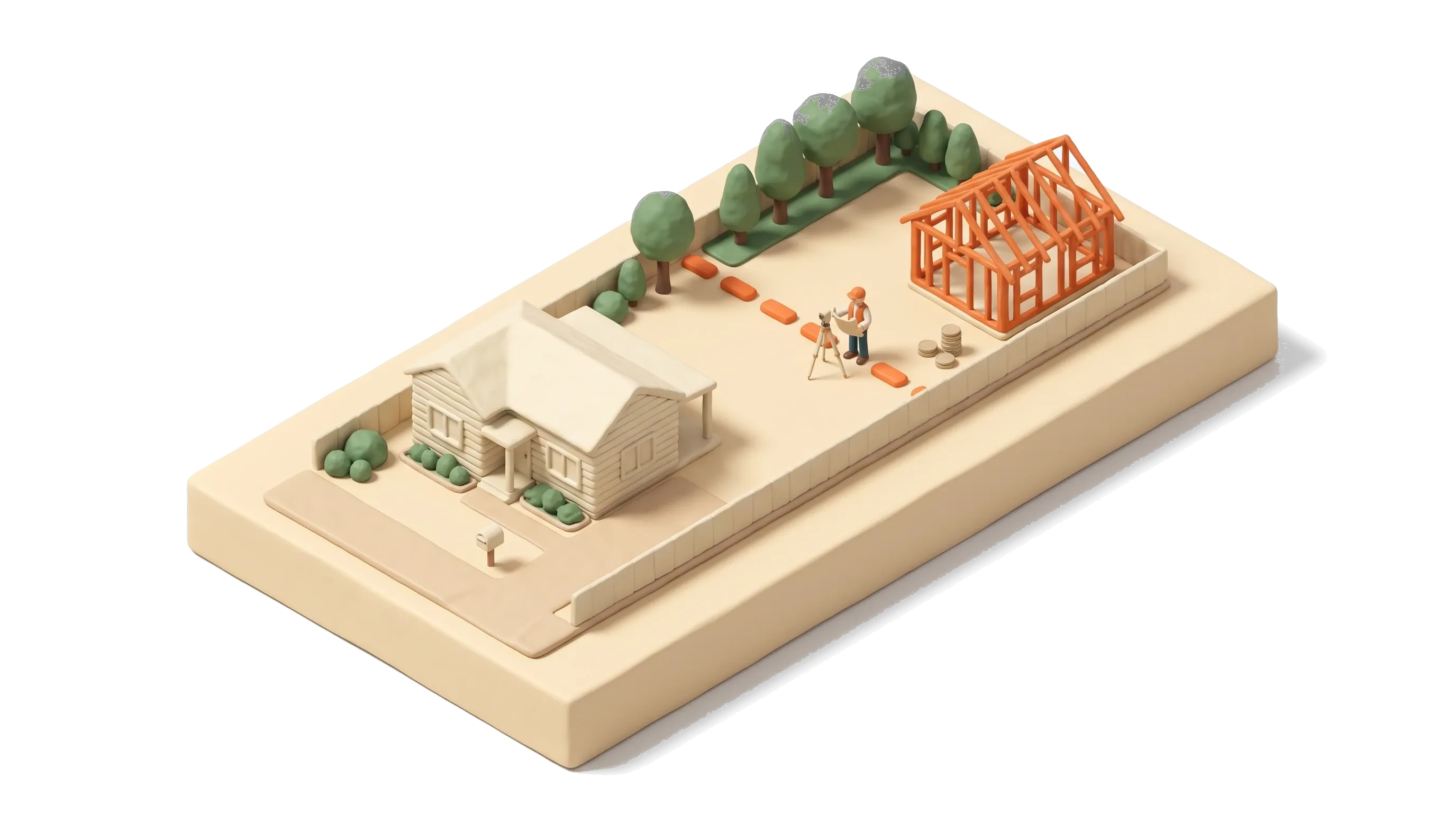

Have you looked at the back of your block and wondered how much it would cost to subdivide the land and put a second home on it?
Do you know which part of the bill is the council’s fee, and which part is the charge that actually decides whether it is worth doing?
And what if the estimate you found online was two years old, and quietly wrong?
Several of them are. Ahead: the short answer and why the usual ranges mislead, the three layers every subdivision bill is made of, the 2026-27 government fees state by state with a worked two-lot split, why you pay contributions on the new lot and not the old one, the site costs no fee schedule shows, and how long the whole thing takes. It is the small-lot chapter of our guide to micro housing in Australia.
How much does it cost to subdivide land? The short answer
The most-quoted answer, from Canstar, is that subdividing land in Australia “could cost anywhere between $30,000 to $90,000”. That was written in May 2024, and it has two problems. Fees have gone up every July since, and a single range hides the fact that the bill is made of very different kinds of cost.
Google’s AI answer does better, with a table of line items, but those are one state’s figures from one feasibility software guide presented as if they applied everywhere.
The honest answer is that the fees are the small part. What decides the budget is the charge on the new lot, which ranges from a few thousand dollars to nearly $40,000 depending on the state, and the site works, which depend on your block.
Subdivision costs in three layers
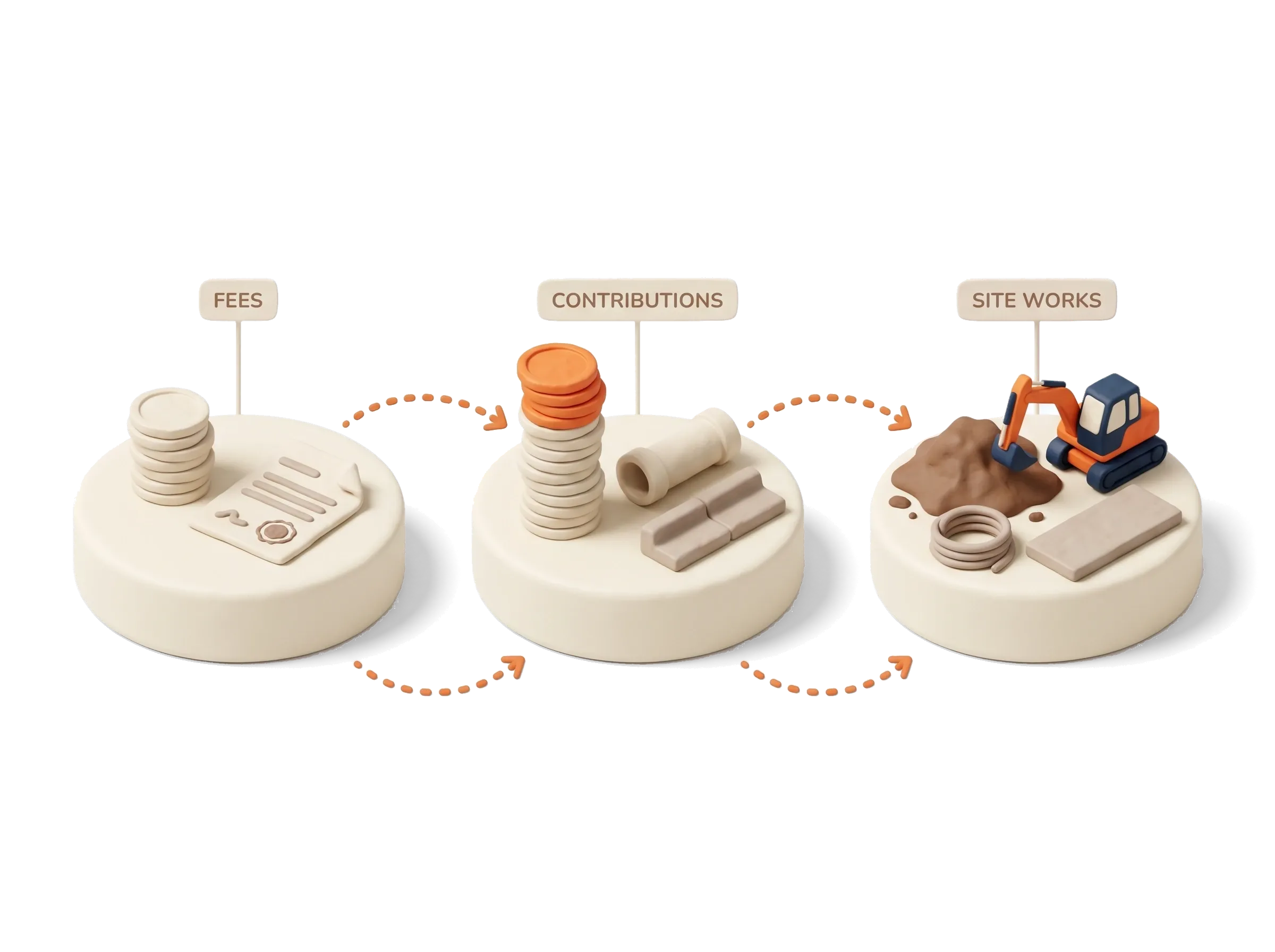
Every subdivision bill, in every state, breaks down the same way:
| Layer | What it covers | How big |
|---|---|---|
| Government fees | Planning application, plan lodgement, titles, certification | Small: often a few thousand dollars |
| Contributions and headworks | State and council infrastructure charges, open space, water and sewer connections for the new lot | The big variable: from about $2,000 to nearly $40,000 per new lot |
| Site works and consultants | Survey, town planning, engineering, demolition, driveway, stormwater, service connections | Depends on the block, and can exceed everything above |
Most of the pages that rank for this question blur the three together, which is why their ranges are so wide. Pulled apart, the first two layers can be read straight off the fee schedules.
The government fees, state by state (2026-27)
Here is what the published 2026-27 schedules charge for a plain one-into-two Torrens split with no new road. It covers the first two layers only: the fees and the state or utility charges on the one new lot. Council charges are noted where they sit on top. The totals are our arithmetic from the figures in each row.
| State | The main charges on a one-into-two | Government total, before site works |
|---|---|---|
| VIC | Plan lodgement $723.30 plus $223.60 per lot (Land Use Victoria); planning permit $1,537.00, or $233.10 under VicSmart; certification and statement of compliance $203.80 | About $2,900 (about $1,600 under VicSmart), plus water and sewer charges and any open space contribution |
| NSW (Greater Sydney) | Housing and Productivity Contribution $13,000.73 on the new lot (NSW Planning); plan lodgement $384.78 per lot (NSW LRS); Sydney Water Section 73 application $723.81; development application fee of about $500 | About $15,000, before council’s local contribution of up to $20,000 per lot |
| QLD | Maximum infrastructure charge $38,029.25 per new lot for a three-bedroom-plus home, $27,163.80 for two bedrooms or fewer (Planning Regulation) | Up to about $38,000 in the charge alone, plus application fees |
| WA | WAPC application $3,837 plus $85 per lot, and endorsement $719 plus $8 per lot; Water Corporation up to $7,918 per new lot (Water Corporation); Landgate plan and titles about $800 | About $13,500 |
| SA (Greater Adelaide) | Open space contribution $10,166 per new allotment (PlanSA fees notice); SA Water $4,017 water and $4,017 wastewater per new infill allotment; application $210 and certificate $1,229 | About $19,600, plus Land Services SA’s plan and title fees |
Read down the right-hand column and the pattern is plain. In Victoria the government’s own fees are close to trivial. Everywhere else the bill is dominated by one charge on the new lot, and that charge is the number to find out first for your own council area. In Queensland, Brisbane City Council’s own share alone is $18,793.33 per new lot under its 2026-27 charges resolution, which is half of the total charge.
Two notes on the figures. They are dated to the 2026-27 financial year and move every July, which is exactly why older estimates drift. And several pages still ranking for this question quote the previous year’s fees, or, in one case, a Queensland cap of $28,000 that has since been indexed to $38,029.25.
Developer contributions: you pay on the new lot, not the old one
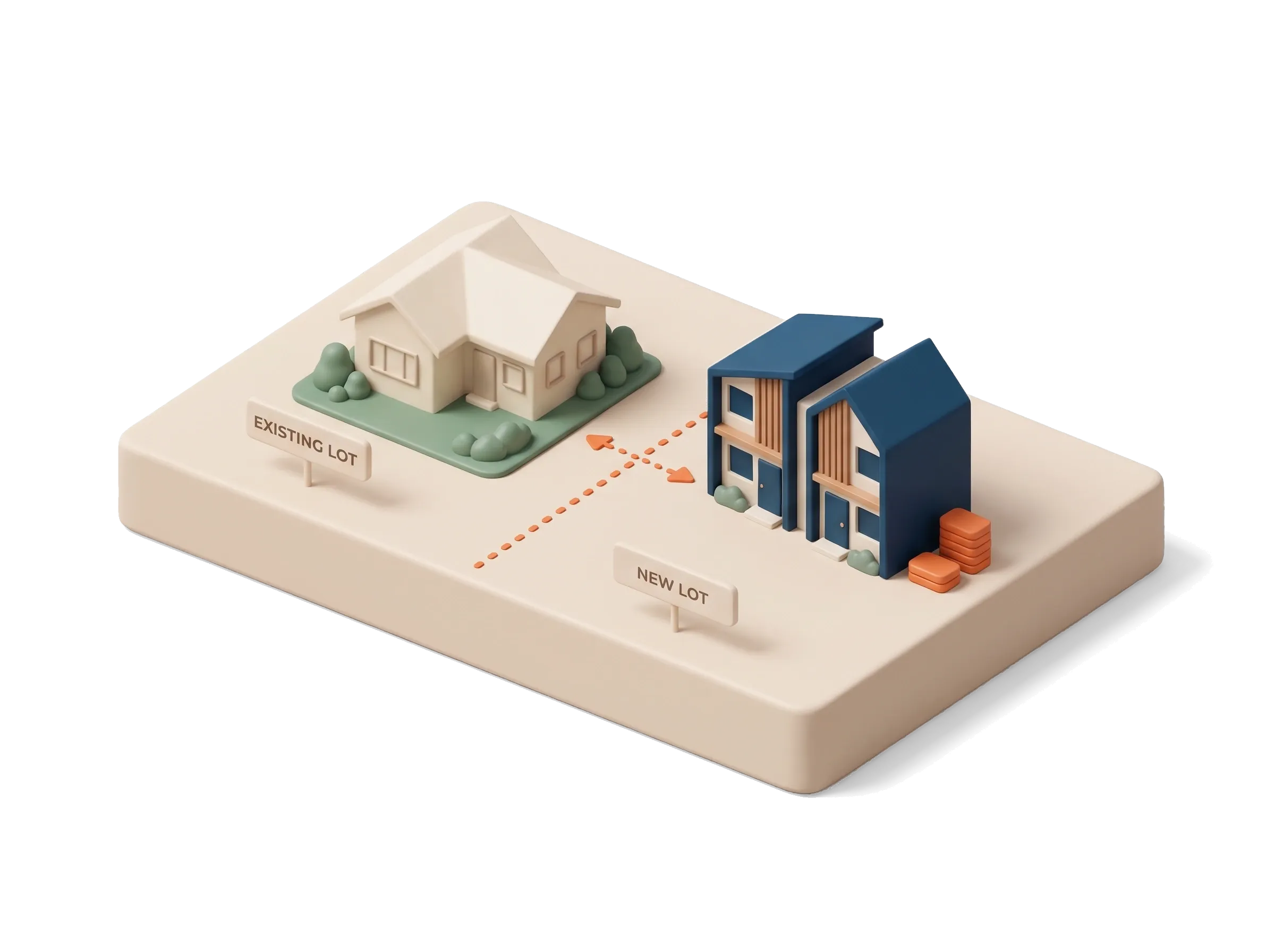
This is the most useful thing to know about developer contributions for a small subdivision, and almost nobody says it.
The charges are levied on the additional lot. The New South Wales contribution counts new lots as those approved minus the lots that could already hold a home, so a one-into-two pays for one. South Australia charges its open space contribution on each new allotment. Victoria’s public open space contribution, up to 5 per cent of the land or its value under section 18 of the Subdivision Act where the planning scheme sets no rate of its own, need not be required for a two-lot subdivision where council considers further subdivision unlikely.
It matters because the per-lot charge is what separates a one-into-two from a one-into-three. The fees barely move with the extra lot. The contributions double.
Site works: the subdivision costs no fee schedule shows
The third layer is the one you cannot look up, because it depends on the land. A surveyor and usually a town planner, an engineer for stormwater and levels, a new crossover and driveway, separate water, sewer, power and telecommunications connections for the new lot, and sometimes demolition or relocation of a shed, a garage or the back of the existing house.
We are not going to put a single number on it, and you should be wary of anyone who does. For a sense of scale, one Brisbane town planner’s 2026 estimate puts earthworks at $5,000 to $50,000 and stormwater at $9,000 to $50,000 on a one-into-two, which is a spread of ten times from one block to the next. The only way to narrow it is a site-specific quote, and that is the first money worth spending.
How long does a subdivision take?
The part with a legal clock is the planning decision. In New South Wales a development application is deemed refused if council has not decided it within 40 days. In Victoria the standard permit clock is 60 statutory days, but since 16 October 2025 many two-lot residential subdivisions qualify for VicSmart, which runs 10 business days with no neighbour notification.
Everything after the permit takes longer: engineering approvals, the works themselves, certification, clearances from the water authority and the titles office. Whole-process estimates in the feasibility guide above run from about six months in South Australia to 12 to 18 months or more in New South Wales and Western Australia, and a block that needs a sewer extension or a retaining wall can take longer still.
Before any of that, check the lot size. In New South Wales the council’s minimum lot size map decides, except in the state’s Low and Mid-Rise Housing areas near nominated stations and town centres, where a dual occupancy lot of 450 m² can be split to 225 m² per lot. In Brisbane, 300 m² lots have been allowed within a 300 m walk of a shopping centre since 18 September 2026. Victoria’s Small Lot Housing Code, for lots under 300 m², applies mainly in the growth areas rather than established suburbs.
When a small-lot subdivision is worth it
The fees are the easy part, and now you have them. Whether a split is worth doing depends on the rest of the feasibility: what the new lot is worth, what the home on it costs to build, and whether the contribution and site works leave a margin once you have paid for both. We work through that sum in the guide chapter on feasibility and residual land value, and through the approval itself in development approvals.
Small lots matter beyond the individual block, too. Splitting well-located land is one of the few ways to add homes to established suburbs without changing the street, which is the argument we make in housing affordability and the size of the homes we build. And a small lot does not always mean a small house: it can mean a pair of townhouses, a granny flat or a micro apartment. If you would rather take part in a project than run one, that is what investing in property development is about.
Frequently asked questions
How much does it cost to subdivide a block into two in NSW?
The state and utility charges for a Torrens one-into-two in Greater Sydney come to roughly $15,000 in 2026-27, most of it the Housing and Productivity Contribution of $13,000.73 on the new lot. Council's own local infrastructure contribution sits on top, and can reach $20,000 per lot without an IPART review. Survey, planning, legal and site works are extra and depend on the block, so a full budget is well above the government charges alone.
Do I pay developer contributions on the existing lot when I subdivide?
Generally no. Contributions are charged on the additional lot. The NSW Housing and Productivity Contribution counts new lots as those approved minus the existing potential dwelling lots, South Australia's open space contribution is charged on each new allotment, and in Victoria the public open space contribution can be waived for a two-lot subdivision where council thinks further subdivision is unlikely.
How long does a subdivision take in Victoria?
Since 16 October 2025 many two-lot residential subdivisions in Victoria qualify for VicSmart, which has a 10 business day permit clock and no neighbour notification, against 60 statutory days for a standard permit. That is only the planning permit. Certification, works, the statement of compliance and titles follow, so the whole process takes months rather than weeks.
What is the minimum lot size to subdivide in NSW?
It is set by each council's local environmental plan, through its minimum lot size map. The exception is the state's Low and Mid-Rise Housing areas, broadly within walking distance of nominated stations and town centres, where a dual occupancy lot of at least 450 m² can be subdivided down to 225 m² per lot. Outside those areas the council map applies.
Sources
- Subdivision fee calculator — Land Use Victoria, accessed September 2026
- Housing and Productivity Contribution — NSW Department of Planning, Housing and Infrastructure, accessed September 2026
- NSW LRS fees 2026-2027 — NSW Land Registry Services, accessed September 2026
- Planning Regulation 2017, Schedule 16 — Queensland Legislation, accessed September 2026
- Subdividing stage infrastructure contributions — Water Corporation, accessed September 2026
- Planning, Development and Infrastructure Fees Notice — PlanSA, accessed September 2026