

Micro housing
Micro Apartments in Australia: How Small Each State Allows, and Who Lives in Them
TL;DR: A micro apartment is a self-contained home built small on purpose, usually under 30 m² by most definitions. Only two states set a minimum size for a new apartment: New South Wales (a 35 m² studio) and Western Australia (36 m²). Victoria and South Australia set room sizes instead. Most smaller units are legally co-living or boarding rooms, with rules of their own.
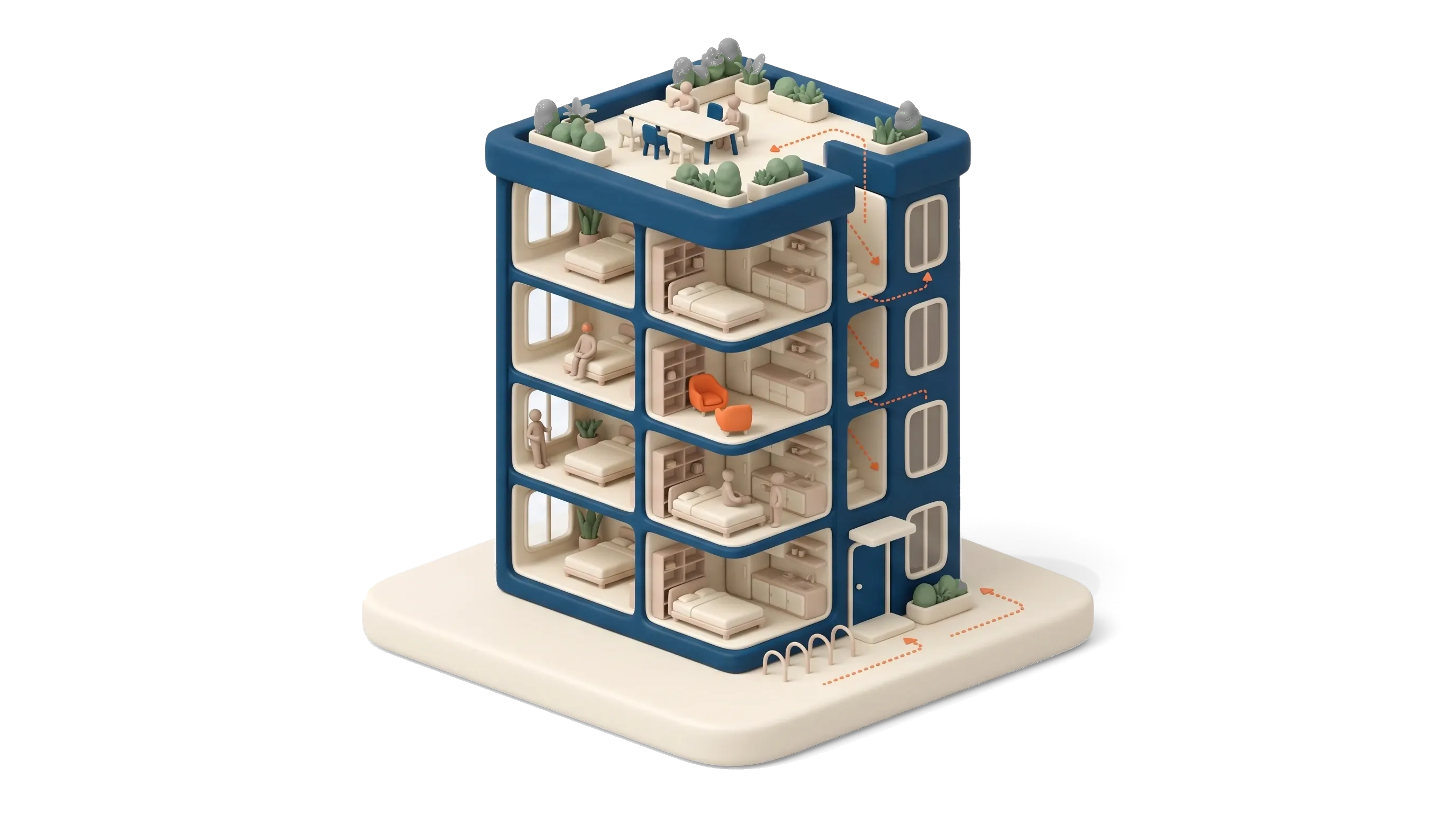

Are micro apartments in Australia a clever answer to high rents, or just a smaller box at a higher price per square metre?
Do you know how small a new apartment is actually allowed to be where you live?
And what if most of the tiny units you have seen advertised are not legally apartments at all?
Most of them are not. Ahead: what counts as a micro apartment, the minimum apartment size state by state, the legal routes that let smaller units get built, who actually lives in them according to the research, and the design rules that decide whether a small home works or just feels small. It is one chapter of our guide to micro housing in Australia.
What are micro apartments? A working definition
Micro apartments are self-contained homes built small on purpose: a studio or one-bedroom with its own kitchen and bathroom, in a building designed around small homes rather than a large one cut up afterwards.
There is no legal definition in Australia, so the useful thing is to know where the lines usually fall. Most definitions put a micro apartment somewhere under 30 m². Canada’s national housing agency, CMHC, uses 29 m² or less. A 2019 UNSW study of Sydney examples looked at units of 24.5 to 28 m². The range you will often see quoted online, 14 to 32 m², is 150 to 350 square feet converted to metric, an American way of counting, which is why it sits oddly against Australian rules.
Those rules are the interesting part, because in two states a self-contained apartment that small cannot be approved as an apartment at all.
Minimum apartment size in Australia, state by state
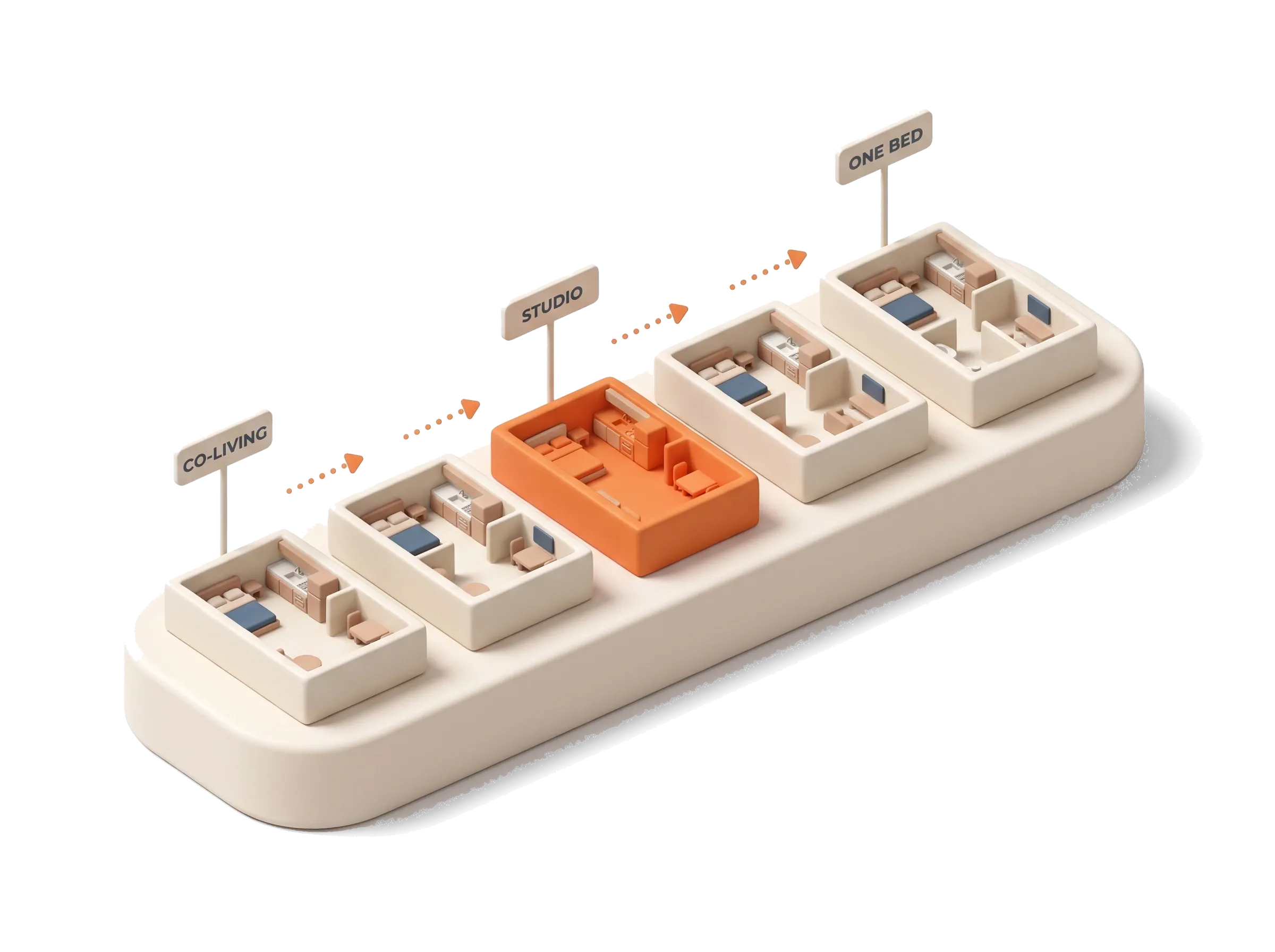
There is no national minimum. Each state decides, and only two of them set a total floor area for a new apartment:
| State | Smallest new studio | What the rules set instead or as well | Source |
|---|---|---|---|
| NSW | 35 m² (1-bed 50, 2-bed 70, 3-bed 90) | 2.7 m ceilings, a window of at least 10% of each room’s floor area, living rooms at least 3.6 m wide in a studio | Apartment Design Guide, 4D-1 |
| WA | 36 m² (1-bed 47, 2-bed 67, 3-bed 90) | Set as an acceptable outcome, with 2.7 m ceilings and 3.6 m living rooms | R-Codes Volume 2, table 4.3a |
| VIC | No minimum | Main bedroom 3 × 3.4 m, living area 3.3 m wide and 10 m² in a studio, 8 m³ of storage | Mid-Rise Code Guidelines, 2026 |
| SA | No minimum | Studio living rooms 3.3 m wide, 6 m³ of storage, a 4 m² balcony | Planning and Design Code |
| QLD | No statewide minimum found | Rooming accommodation rules instead (below) | Planning Queensland |
Victoria is the one to watch. A Parliament of Victoria inquiry recommended a minimum apartment size in August 2022. The government’s March 2024 response said it would “explore” the idea, and the Mid-Rise Code that took effect on 16 April 2026 set tighter room sizes but still no overall minimum.
Here is how those numbers line up against the smallest rooms the rules allow, and against our own design:
- Co-living room, single, minimum NSW, excluding kitchen and bathroom12 m²
- Co-living room, maximum NSW, excluding kitchen and bathroom25 m²
- Studio apartment, minimum NSW Apartment Design Guide35 m²
- Studio apartment, minimum WA R-Codes Volume 236 m²
- Our micro apartment design Internal area, 4.7 m × 8.8 m41.36 m²
- One-bedroom apartment, minimum WA R-Codes Volume 247 m²
- One-bedroom apartment, minimum NSW Apartment Design Guide50 m²
Why tiny units exist below the minimum: co-living and boarding houses
If New South Wales will not approve a studio under 35 m², how do 25 m² units get built in Sydney? Mostly by being something else in law.
In New South Wales the answer is co-living or a boarding house, both under the Housing SEPP. Each private room must be between 12 m² (16 m² for two people) and 25 m², not counting any private kitchen or bathroom, so a room can carry its own kitchenette and still sit well under the apartment minimum. Before November 2021 the same kind of unit came through the “new generation boarding house” route of an earlier policy, which is the route the UNSW research below looked at.
The categories are easy to confuse, so here they are side by side:
| Micro apartment | Co-living (NSW) | Boarding house (NSW) | |
|---|---|---|---|
| Self-contained? | Yes | Room plus shared living | Room plus shared living |
| Size rule | 35 m² studio minimum | Room 12 to 25 m² | Room 12 to 25 m² |
| Affordability condition | None | None | Affordable in perpetuity |
| Who runs it | Owner or strata | A manager on call 24 hours | A registered community housing provider |
| Floor space bonus | None | 10% | 30% |
The NSW planning department’s summary adds that co-living needs at least six rooms, though most schemes have 30 to 40, and that every tenancy runs for at least three months.
Other states draw the line differently. In Queensland, small rooming accommodation of up to five bedrooms and five occupants needs no planning approval in lower-density zones, a concession Planning Queensland says expires on 2 December 2026. In Victoria a rented building with four or more residents is a rooming house, as Victoria Legal Aid explains, with its own minimum standards.
Who actually lives in micro apartments
The honest answer is younger than the marketing suggests.
When UNSW’s City Futures Research Centre surveyed the occupants of recent boarding house developments in central and southern Sydney, it found they were mostly students and younger workers, and that 9 in 10 of the low-income occupants were still in rental stress. A companion UNSW thesis on 24.5 to 28 m² units reached a blunter verdict: more supply, compromised amenity, and no clear affordability benefit.
Purpose-built projects can reach further. Nightingale’s building in Marrickville, reported by the ABC, has 54 units of about 25 m² rented at 80 per cent of market rent, with income caps and about one in five homes set aside for priority groups. Its shared kitchens and roof terraces are what make the small private rooms work, and ArchitectureAU reported 177 applicants for the first homes. In Perth, the City of Vincent saw a seven-storey co-living building of 88 small apartments approved in June 2025.
Further afield, when Canada’s housing agency evaluated a Vancouver micro-suite building, 84 per cent of tenants said they were satisfied or neutral about living there. Its own caution is worth repeating: micro does not always mean affordable.
Small-home design: what makes a micro apartment work
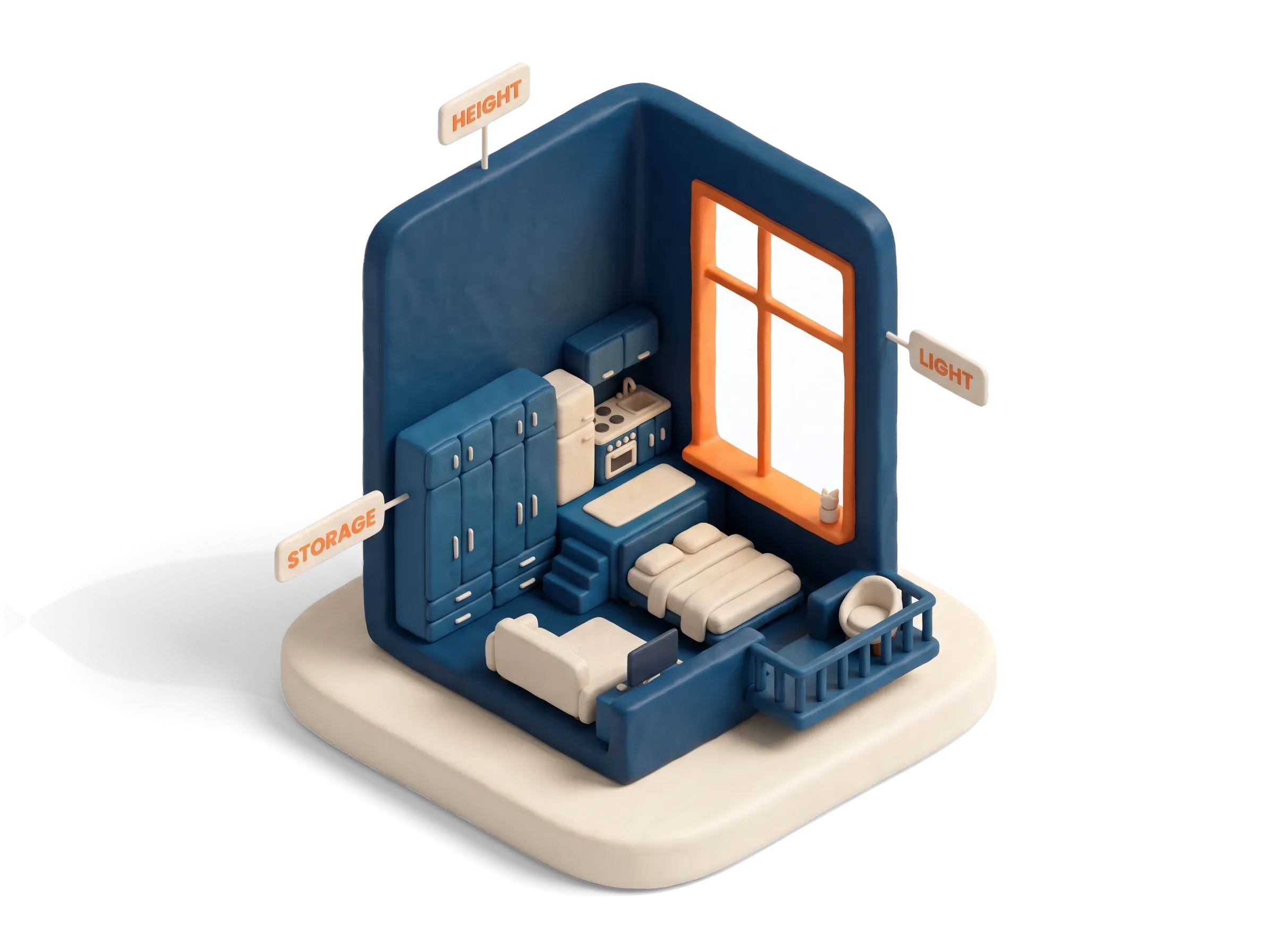
The New South Wales rules read, in the end, like a design checklist for a good small home, and they are worth borrowing wherever you are:
- Height. Ceilings of at least 2.7 m in habitable rooms. Volume is the cheapest way to make a small floor plan feel generous.
- Daylight. Every habitable room needs a window in an outside wall of at least 10 per cent of its floor area, and daylight cannot be borrowed from another room.
- Depth. A room no deeper than 2.5 times its ceiling height, and an open-plan layout no more than 8 m from a window.
- Width. A studio’s living room at least 3.6 m wide, so it cannot be made small by being made narrow.
- Storage. At least 4 m³ in a studio beyond the kitchen, bathroom and bedroom storage, half of it inside the home. Victoria asks for 8 m³.
- Outside. A studio balcony of at least 4 m².
Our own micro apartment design starts from the same list and pushes on height: 41.36 m² with 3.6 m ceilings, a bathroom raised on a platform and a bed that rolls away underneath it, so the least-used part of the home stops taking up floor space during the day. You can walk through it in 3D.
Are micro apartments a good idea? The honest answer
They are a good idea in a narrow set of places, and a poor one outside them.
They work where the location is doing the heavy lifting: near transport, work and study, with shared space that makes up for the private space given away, and at a size that still passes the rules above. They fail when size is the only thing on offer. When the ABC visited a Brisbane house split into five micro apartments renting for upwards of $400 a week, Tenants Queensland’s Penny Carr was blunt: at that price, it is not affordable housing.
So the case for micro apartments is not that small is cheap. It is that the mix of homes Australia builds is badly skewed towards large ones, which we set out with the affordability numbers in housing affordability and the size of the homes we build. Micro apartments are one way to fix the mix. Small lots are another, and the cost of splitting a block is in what it costs to subdivide land. If you want to be on the development side of new small homes rather than paying retail for one, that is what buying at developer cost price is about.
Frequently asked questions
What is the minimum size of a studio apartment in NSW?
35 m² of internal area, under objective 4D-1 of the NSW Apartment Design Guide. That figure assumes one bathroom; each extra bathroom adds 5 m². A one-bedroom apartment must be at least 50 m², a two-bedroom 70 m² and a three-bedroom 90 m². A design that falls short is assessed on its merits rather than refused outright.
Does Victoria have a minimum apartment size?
No. Victoria regulates bedroom and living room dimensions, storage and balconies, but not the total floor area of an apartment. A Parliament of Victoria inquiry recommended a minimum size in August 2022, and the government's March 2024 response said it would explore spatial guidance including apartment size. The Mid-Rise Code that took effect on 16 April 2026 set room sizes but still no overall minimum.
What is the difference between co-living and a boarding house in NSW?
Both are private rooms of 12 to 25 m², not counting any private kitchen or bathroom, with shared living space, and both need tenancies of at least three months. The difference is who they are for. A boarding house must provide affordable housing and be run by a registered community housing provider, and earns a 30 per cent floor space bonus. Co-living has no affordability requirement, needs at least six rooms and a manager on call around the clock, and earns 10 per cent.
Who lives in micro apartments in Australia?
Mostly students and younger workers. A 2019 UNSW City Futures survey of recent boarding house developments in central and southern Sydney, which are the closest thing to micro apartments most cities have, found their occupants were largely students and younger workers rather than the low-income renters the policy was written for. Purpose-built projects with income caps, like Nightingale in Marrickville, reach a wider group.
What is a rooming house?
It depends on the state. In Victoria a rooming house is a building where one or more rooms are rented out and four or more people live in total, according to Victoria Legal Aid. In Queensland, small rooming accommodation of up to five bedrooms and five occupants needs no planning approval in lower-density zones, though that concession is due to expire on 2 December 2026. Building approval is still required.
Sources
- Apartment Design Guide — NSW Department of Planning, accessed September 2026
- State Planning Policy 7.3, Residential Design Codes Volume 2: Apartments — Western Australian Planning Commission, accessed September 2026
- Inquiry into apartment design standards — Parliament of Victoria, accessed September 2026
- State Environmental Planning Policy (Housing) 2021 — NSW Legislation, accessed September 2026
- Affordable rental housing policy not delivering for low-income earners — UNSW Newsroom, accessed September 2026
- First tenants prepare to move into Marrickville micro apartments — ABC News, accessed September 2026