

The Dual Lens Method
Where to buy investment property in Australia, and what to pay for it
Two questions decide every property investment: where you buy, and the price you get in at. Most guides answer the first with a list of suburbs that dates in a month. This one gives you the method, from 15,000 suburbs down to one brand new home at developer cost price.
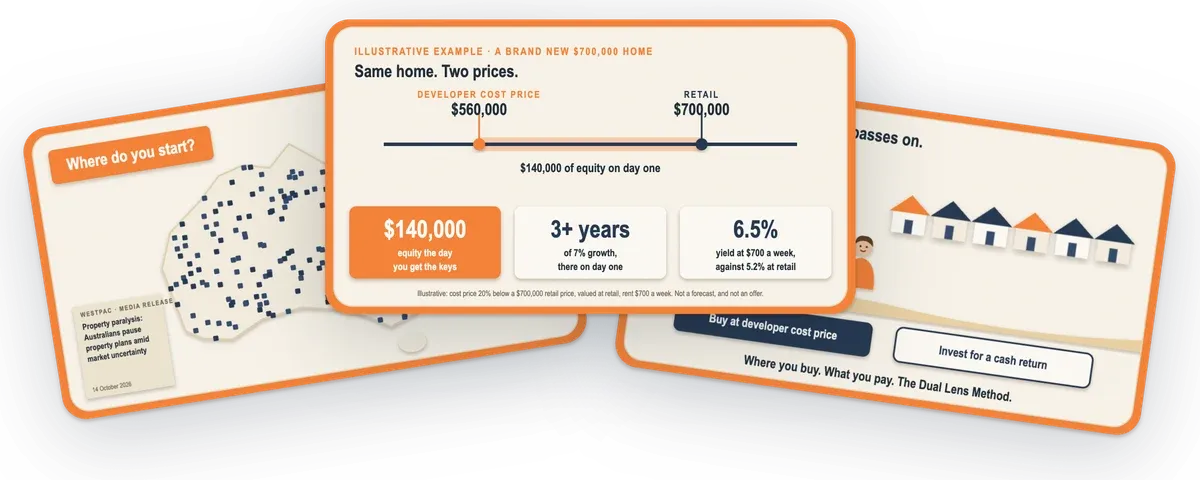
How developers and investors beat the 2026 market: equity on day one, a stronger rent, and the next property funded by the first.
It works whatever the market is doing, because it doesn't wait for growth to arrive. Pick the suburb from supply and demand, then buy at developer cost price, so the capital growth, the rental return and the equity are there the day you get the keys. Press play, or step through. The chapters below give you the working.
Scene 1
There are more than 15,000 suburbs. Where do you start?
There are more than fifteen thousand suburbs in Australia. So where do you start?
Every property decision comes down to two questions

Where should I buy? And what should I pay? Almost every strategy you will read about, growth, yield, renovation, development, is an answer to one of those two. The trouble is that the two work on you independently. The location does not care what you paid. The price works on you wherever you bought. So a strategy that answers only one of them leaves the other to luck.
The Dual Lens Method looks through both. The growth lens chooses the location from supply and demand, suburb by suburb. The price lens sets the entry at developer cost price, so the equity is there the day you get the keys. Chapter 1 sets out both lenses and why you want them together.
Where is the best place to buy an investment property in Australia right now?
The honest answer is that nobody can name it for you in advance. The pages that try give you a list of suburbs with a year in the title, and the list is stale by the time you act on it. What you can have is a way of finding the answer yourself, whenever you need it.
It starts at the top. The macro market tells you what the tide is doing: rates, credit, migration, the supply of new homes and policy. Then the real work happens one level down. More than 15,000 suburbs, each scored on buyer demand against the homes for sale, with houses and units read separately. Nine signals cut that to a shortlist, and Boomscore, our sister research site, does the counting for free. Then you check the few that remain against the fundamentals: jobs, transport, schools and shops, and who is moving in. The figures find the suburbs. The ground truth confirms them.
Worried about a falling market? This is where the opportunities are
A falling market is the reason the method exists. After the GFC, from 2010 to 2013, the Australian market fell 1.7%. The suburbs that Boomscore ranked highest grew 11.85% over the same period, and the experts' picks grew 7.3%. Past performance is not a reliable indicator of future performance, but it shows what reading demand against supply can do when the average is going backwards.
A slow market also helps the developer's side of the table: sellers of development sites will talk on price and terms, more lenders will fund a build with no presales, and the homes started now finish into a shortage. Chapter 5 is about reading the cycle, and when a suburb's own trend says buy.
From suburb to site: how one block drops out the bottom
Boomscore stops at the suburb. The last step of the growth lens is ours: the zoning, the block and the numbers. A site is worth what a feasibility says it is worth and not a dollar more, and chapter 6 walks through how a development site is found and tested. On that site we build brand new homes, UrbanHaus apartments or TownHaus townhouses, where the demand already is.
The second lens: the price you pay
Take a brand new home with a retail price of $700,000. Buy it at developer cost price, 20% less, and you pay $560,000. If it values at retail, that is $140,000 of equity on day one, about three years of 7% growth, there before the market has done anything. And at $700 a week in rent, the yield on what you paid is 6.5%, against 5.2% at retail. Illustrative figures, and not an offer, but the shape is the point: the price lens works on you wherever you bought.
Then the part most guides never reach. That equity does not sit there. When the finished home is refinanced at its valuation, your original investment can come back out and the development profit stays in the home as the deposit, which is how one project becomes a portfolio rather than a one-off. Chapter 9 turns it into a plan, step by step.
Take a completed home at developer cost price instead of retail. The margin you would have paid becomes manufactured capital growth: instant equity, a boosted rental yield, and a deposit that frees your original capital.
Join for this path → See the cost-price pathPut capital into the development and take a cash return at completion, paid from the profits ahead of the developers' share, without carrying the bank debt or running the build yourself.
Join for this path → See how co-development worksThe nine chapters
In order, ideally. The guide runs the way the method does: the market first, then the suburb, then the site, then the price, and only then what the equity does next.
- 01 Beating the property market in 2026: every decision comes down to two questions Where you buy and what you pay. The growth lens and the price lens, why they work on you independently, and why a strategy that uses only one of them is half a strategy.
- 02 Australia's property market outlook: start at the top, but don't stop there Rates, credit, population, new supply, policy and the cycle. What the national picture can tell you, and the big thing it can't: the suburbs moving against it.
- 03 Where is the next property boom? From 15,000 suburbs to a shortlist Supply against demand, read through nine signals, with houses and units scored separately. How to build your own shortlist instead of trusting someone else's list.
- 04 What actually drives growth in a suburb? The figures find it, the fundamentals check it Statistical research finds the suburbs where demand is outrunning supply. Fundamental research checks why, and whether it will last. You need both, in that order.
- 05 When to buy an investment property: read the trend, not the headline A high score is good, a rising one is better, a falling one is a warning. How to read the cycle suburb by suburb, and the same signals in reverse for when to sell.
- 06 From suburb to site: how one development site drops out the bottom Zoning, the block, the overlays and a feasibility that works backwards from the finished value. How a shortlisted suburb becomes one buildable site, and why a slow market suits a developer.
- 07 The second lens: what you pay decides what you start with Retail against developer cost price, the equity on day one, the yield that comes with it, and how an investment in the development can come back out. Short, with the full detail in the property development guide.
- 08 Both lenses on one project: Sapphire Place, ten years on A completed townhouse at Palm Beach on the Gold Coast, followed from the research to the settlement to today. What the growth lens did, what the price lens did, and what neither could have done alone.
- 09 Buying an investment property: your plan, step by step, with both lenses A numbered checklist for buying an investment property in Australia, from the money to the suburb to the price to the second property, with the free tool for each step.
Go deeper: the tools and the proof
- 01 Boomscore Hotspot Finder Rank more than 15,000 suburbs on demand against supply, for your budget and property type. Free.
- 02 The Essential Guide to Property Market Research The growth lens in full, on Boomscore: the nine signals, why one number lies, and how to time the market.
- 03 The manufactured equity calculator Put your own numbers through the price lens.
- 04 Sapphire Place, Palm Beach: both lenses on one project A completed project, with the dated figures, from cost price to a decade of growth.
- 05 The Property Development Guide How the price lens is built: twelve chapters on development, cost price and co-development.
Where to buy investment property: quick answers
Where is the best place to buy an investment property in Australia right now?
Nobody can name it for you in advance, and a list that tries will be out of date by the time you read it. What works is a method: start with every suburb, rank them on buyer demand against the homes for sale, check the fundamentals of the few that come out on top, and then make sure the price you pay leaves you equity on day one. That is what this guide teaches, and the free tools in it let you build your own shortlist this week.
Which state in Australia is best for investment property?
None of them, as a whole. A state average hides suburbs moving in opposite directions, and the gap between a strong suburb and a weak one inside the same city is usually bigger than the gap between states. Research works at suburb level, with houses and units read separately, which is why Boomscore scores more than 15,000 suburbs rather than eight states.
Is it a good idea to buy an investment property now, in a falling market?
A falling market is where the two lenses matter most. The growth lens finds the suburbs where demand still outruns supply: after the GFC, from 2010 to 2013, the market fell 1.7% while the top-ranked suburbs grew 11.85%. The price lens protects you whatever the market does, because equity you start with does not depend on growth arriving. Past performance is not a reliable indicator of future performance, and nothing here is advice for your situation.
How do you find high-growth suburbs?
Read supply against demand. Nine signals do most of the work: days on market, vendor discounting, auction clearance, gross rental yield, stock on market, online search interest, vacancy rate, the proportion of renters and the market absorption rate. When demand is rising and the homes for sale are shrinking, prices and rents follow. Then check the fundamentals on the ground: jobs, transport, schools and shops, and who is moving in.
Is this guide an investment offer?
No. It is general information and education, and it deliberately names no current project, price or return. Any project we offer is discussed with you personally, and only after we have spoken.
Read it, then put both lenses on your next decision.
Join the community and tell us which path fits. It costs nothing, there is no obligation, and no specific offer is made until we have spoken personally.
Join the community