

Can you buy property below market value?
On an established home, rarely, and usually because something is wrong with the home or the seller is in trouble. On a brand new home, yes, reliably, because every new home has two prices and most buyers only ever see one of them.
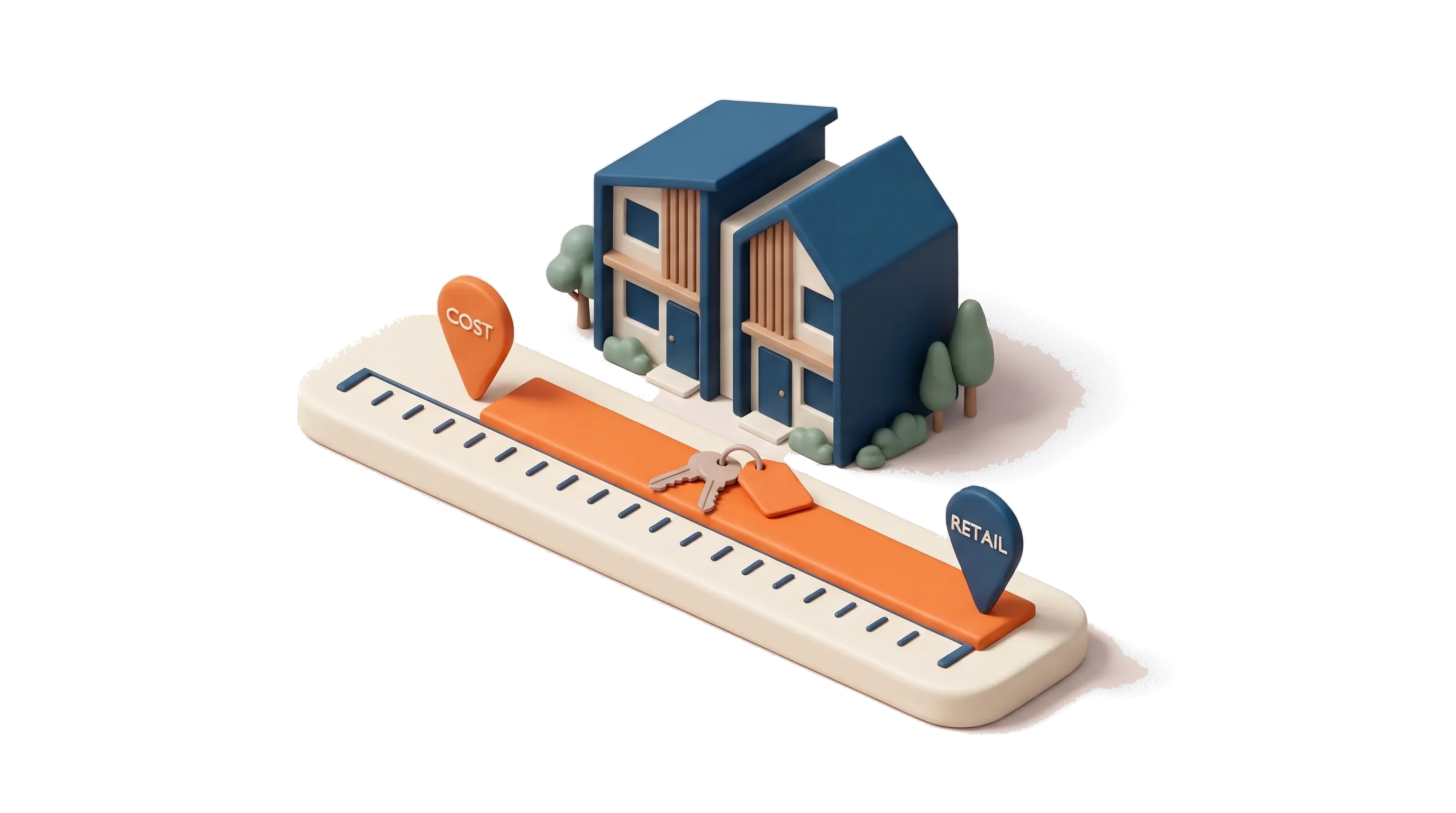
The first is the retail price: what a buyer off the plan pays. Inside it sit the developer’s margin, the marketing budget, the display suite and the sales commissions. All real costs of selling a property. None of them add a dollar to the home itself. The second is the developer’s cost price: the land, the approvals, the build and the costs of delivery. The gap between the two is usually around 20 per cent of the retail price.
Only two of the nineteen top-ranking pages we read on where to buy an investment property even mentioned the price you pay. Chapter 1 of the property development guide pulls a real retail price apart line by line: every new property has two prices.
Same home, two prices: a worked example
Here is the idea with round numbers. It’s an illustrative home, not a project, so no figure here will date or describe an offer.
| At retail | At developer cost price | |
|---|---|---|
| What you pay | $700,000 | $560,000 |
| What it’s valued at on completion | $700,000 | $700,000 |
| Equity on day one | $0 | $140,000 |
| Rent | $700 a week | $700 a week |
| Gross yield on what you paid | 5.2% | 6.5% |
Illustrative: a brand new home with a retail price of $700,000, cost price 20 per cent below, valued at the retail price on completion, rented at $700 a week. Before costs. Not a forecast, and not an offer.
Two things happen at once.
You start with equity. $140,000 is the equivalent of more than three years of 7 per cent organic capital growth, and it’s there the day you get the keys. Nobody waited for the market to produce it. It’s manufactured equity: growth you built rather than growth you waited for. The property development guide’s chapter on manufactured equity explains where it comes from.
You earn more on your money. The tenant pays the market rent whatever you paid. $36,400 a year is 5.2 per cent of $700,000 and 6.5 per cent of $560,000. That gap is there every year you own the home.
You can run your own version, with your own numbers, in the manufactured equity calculator.
Why the developer’s margin exists at all
Because developing is slow and risky, and the margin is the reward for carrying it. The developer spends a couple of years finding the site, funding it, getting it approved and building it. The retail buyer spends a Saturday at a display suite. The margin isn’t a scam. It’s the price of skipping the two years.
Which is why there are only two honest ways to stand on the cost-price side of the ledger: be the developer, or invest alongside one.
How an investment in the development can come back out
This is where the price lens starts to compound. Here’s the same illustrative home, with the money traced through.
- You invest $233,000 in the development as an equity investment in the project.
- On completion the home is valued at $700,000, and you take it at the developer’s cost price, $560,000.
- The bank lends 80 per cent of the value: $560,000, the whole cost price.
- Your $233,000 comes back out. The $140,000 development profit stays in the home as your 20 per cent deposit.
Illustrative: a $233,000 equity investment in the project, the home taken at cost price on completion and refinanced at 80 per cent of the valuation. Before costs. Not an offer.
Your original investment is then free to go into the next project, while the first home keeps its own equity. That matters more than it sounds, because most property investors stop at one, and chapter 9 shows by how much. Whether the numbers suit your own situation is a conversation to have with your broker and adviser, and with us before any project is offered.
Two ways to stand on the cost-price side
FracHaus offers two, and they suit different people.
- Acquire a home at developer cost price. You invest in the project and take a finished home at cost. You get the equity on day one and the higher yield, and you own the home for as long as you choose. How the cost-price path works.
- Invest for a cash return. You invest in the project and take your share of its profit when the homes are sold or refinanced, rather than keeping a home. Each project quotes a preferred return, paid from its profits ahead of the developers’ share; it isn’t guaranteed. How co-development works.
What the price lens can’t do
It doesn’t fix a bad location. A discount in an oversupplied suburb is a discount on the wrong asset, and the market can take the head start back. That’s why this is the second lens, not the first.
It doesn’t remove development risk either. Valuations can come in lower than expected, costs can rise and builds can run late. Being on the cost-price side means sharing in those risks, and we’d be wary of anyone who says otherwise. The property development guide names them honestly in property development risks.
What it does is set your starting point. The growth lens decides what the market does for you afterwards. The price lens decides what you start with. The next chapter puts both on one completed project and follows it for ten years.