
Market news
Rental Yields Australia 2026: Rents Rise While Prices Fall, and the 2027 Rules Reward New Stock
TL;DR: Australia's gross rental yield reached 3.79 per cent in August 2026, the highest since September 2019, because rents rose 5.7 per cent over the year while home values fell. Vacancy is 1.3 per cent nationally and under 1 per cent in five capitals. Approvals are finally rising but completions are years away, and from 1 July 2027 negative gearing is limited to new builds, so the yield story and the tax story now point at the same stock.


Have you looked at the rental yields on offer in Australia in 2026 and wondered how they got to a seven-year high in a year prices fell?
Do you know what a 1.3 per cent vacancy rate actually means for a tenant trying to find a place, or a landlord trying to keep one?
And what if the two big stories of the year, falling prices and the 2027 tax changes, are quietly pointing at the same kind of property?
They are. Ahead: the yield number and where it came from, the arithmetic of rents up and prices down, what vacancy looks like city by city, why the supply response is real but late, and how the tax rules landing in July 2027 fit into the picture.
Commentary, not advice. The framework sits in where and when to buy or sell residential property.
Rental yields Australia 2026: 3.79 per cent gross, the highest since September 2019
The headline everyone quotes from the Cotality Home Value Index for August is the 0.9 per cent fall in home values. The number that pays the mortgage is further down the report. National rents rose 5.7 per cent over the year to August, which Cotality puts at roughly $38 a week on the median rental. Over five years rents are up 39 per cent, or about $200 a week more than a tenant was paying in 2021.
Set that against a falling price and you get the figure that matters to an investor: the national gross rental yield reached 3.79 per cent in August, the highest since September 2019. Darwin leads the capitals at 6.3 per cent, Hobart is at 4.4 per cent, and the national vacancy rate on Cotality’s measure is 1.9 per cent.
A gross yield is annual rent divided by value, before costs. It goes up for one of two reasons: rents rise faster than prices, or prices fall while rents keep rising. For most of the last decade it was the first. In 2026 it is both at once, which is why the move has been sharp rather than gradual.
Rents rising while house prices fall: the arithmetic behind the yield

Prices and rents answer to different masters. Prices answer to borrowing capacity. The Reserve Bank has lifted the cash rate three times this year to 4.35 per cent, and its August statement noted that “new housing loans [are] declining noticeably.” Smaller loans, smaller offers, softer prices. That chain is covered in what a rate move does to a small development and in our companion post on the 2026 property downturn.
Rents answer to something simpler: how many households need somewhere to live, against how many dwellings exist. Rate rises do nothing to shrink the first number. If anything they add to it, because the household that can no longer get the loan does not vanish, it keeps renting. So the same policy that subtracts from buyer demand adds to rental demand, at the same moment.
Domain’s chief of research, Dr Nicola Powell, put the structural side of it this way alongside the June quarter House Price Report: “Strong population growth, limited housing supply and elevated construction costs continue to support prices, but affordability is now the dominant force shaping the market.” Population and supply are the rent story. Affordability is the price story. They are running in opposite directions, and yield is the gap between them.
One more detail from Powell’s report worth keeping: “The unit market is providing one of the clearest signs of changing conditions.” Units are where both stories meet, because they are the entry price for buyers and the entry price for renters. PropTrack has unit prices up 3.0 per cent over the year against 1.5 per cent for houses, so on the price side the smaller dwelling is holding up better. On the rent side it is the other way around: SQM has house rents up 8.7 per cent over the year against 7.1 per cent for units. Houses are where the rent growth is; units are where the price resilience is. That split matters when you are choosing what to build, because the two halves of a yield are not moving together.
Rental vacancy rate Australia 2026: 1.3 per cent nationally, under 1 per cent in five capitals
SQM Research counts vacancies dwelling by dwelling, and its June figure was 1.3 per cent nationally, up from 1.2 per cent in May. In dwellings rather than percentages that is 39,229 empty rentals across the country, against 37,844 the month before. So the market is easing at the margin. It is easing from a level most people would still call a crisis: a balanced rental market is usually taken to sit around 3 per cent, which is more than double where we are.
The split by city is the real story, and the direction of travel matters as much as the level:
| City | Vacancy, June 2026 | Change on May | Rentals available |
|---|---|---|---|
| Canberra | 1.7% | up from 1.6% | 1,063 |
| Sydney | 1.6% | up from 1.5% | 11,957 |
| Melbourne | 1.6% | steady | 8,640 |
| Brisbane | 0.9% | unchanged | 3,065 |
| Adelaide | 0.7% | unchanged | 1,096 |
| Hobart | 0.7% | up from 0.6% | 185 |
| Perth | 0.6% | down from 0.7% | 1,247 |
| Darwin | 0.3% | unchanged | 64 |
Read the last column rather than the first. Darwin’s 0.3 per cent is 64 dwellings available in an entire city, and Hobart’s 0.7 per cent is 185. Sydney, Melbourne and Canberra, the three cities leading the price falls, are also the only three above 1.5 per cent and the only ones where availability is genuinely improving. Everywhere else is flat or tightening.
SQM’s managing director Louis Christopher was careful not to oversell the easing: “While the national vacancy rate has edged up to 1.3 per cent, Australia’s rental market remains exceptionally tight by historical standards.” And on the cities that matter most for yield: “Perth and Darwin remain particularly constrained, with vacancy rates of just 0.6 per cent and 0.3 per cent respectively. Without a substantial increase in the supply of rental housing, affordability pressures are likely to remain a challenge for tenants for some time yet.”
SQM’s own rent series runs hotter than Cotality’s. Where Cotality has rents up 5.7 per cent over the year, SQM’s advertised rents are 8.1 per cent higher than a year ago, at a national combined average of $697.43 a week and a capital city average of $793.63. Different samples, same direction: SQM measures what is being asked on new listings, Cotality measures the whole rental stock, and asking rents always move first.
There is a moderation signal underneath both, and it is worth noting honestly. Combined rents eased 0.4 per cent over the past 30 days, with house rents down 0.5 per cent on the month and unit rents down 0.2 per cent, even while the annual figures stay high. Whichever index you prefer, rents are still growing well above inflation in a year when prices are not growing at all. But the monthly prints say the pace is starting to come off.
Housing supply lag in Australia: approvals are up, completions are years away
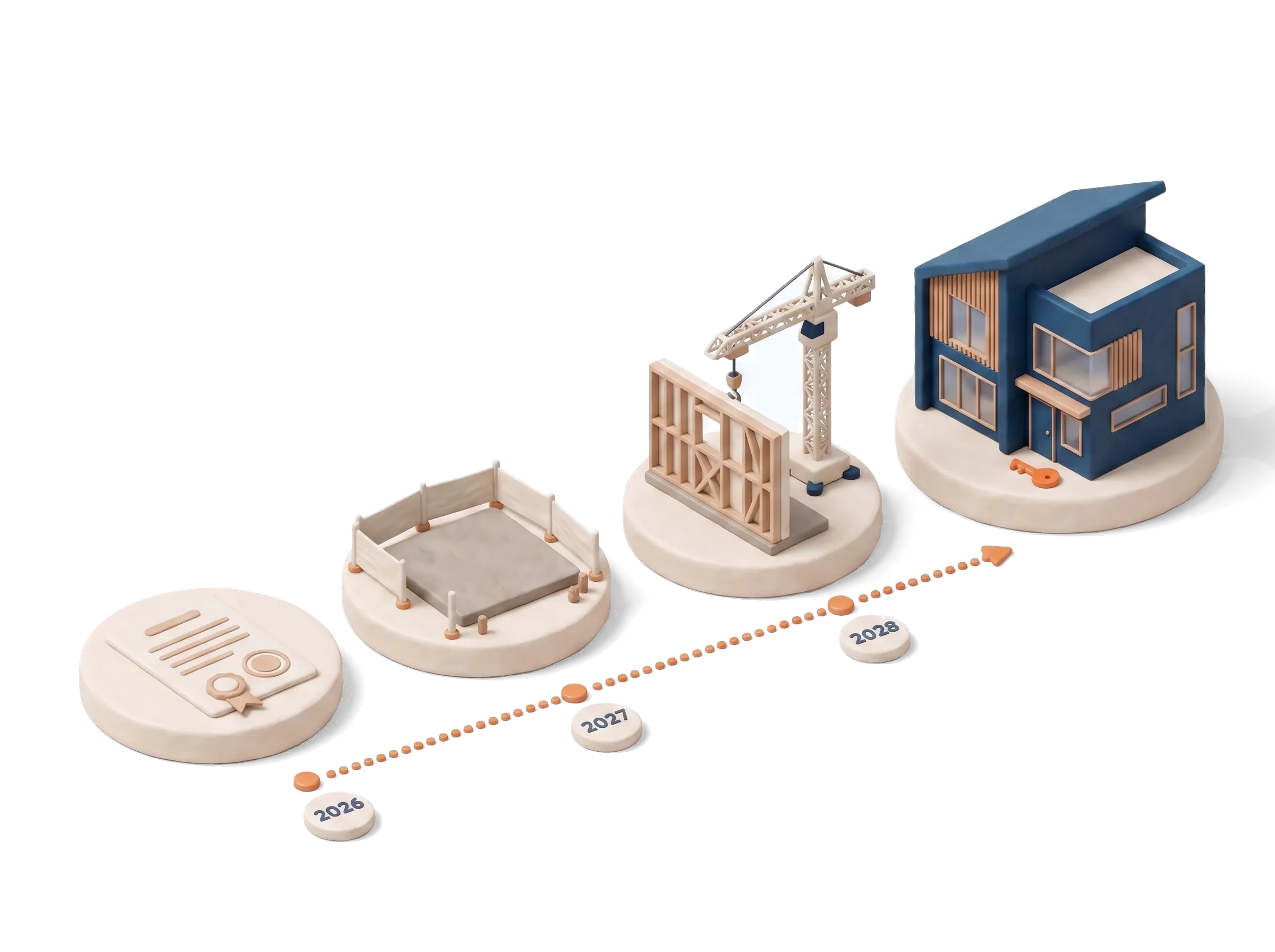
The good news is that the pipeline has turned. The ABS counted 205,249 dwelling approvals in 2025-26, up 9.2 per cent on the year before. Private house approvals were the highest since 2021-22 and approvals for everything that is not a house, which is mostly townhouses and apartments, were the highest since 2017-18. June alone brought 4,888 apartment approvals, a jump of nearly 70 per cent on May, and the ABS’s Daniel Rossi noted that “approvals for private dwellings excluding houses rose by 17.8 per cent in June.”
The less good news is the lag. An approval is a piece of paper. A house takes a year or more from approval to keys, an apartment building considerably longer, and a proportion of approvals never start at all, especially when a price downturn squeezes the margin on projects that were marginal to begin with. We covered how to read the series without being fooled by a good month in building approvals data: signal versus noise. The short version is that the homes approved in June 2026 mostly arrive in 2028 and 2029, and the rental market has to get through 2027 first.
Christopher’s forecast at the start of the year was that 2026 might be “the first year since Covid where there is a balance of sorts between new supply and the expansion in underlying demand.” On the vacancy numbers, that balance is arriving in Sydney and Melbourne and nowhere else.
From 1 July 2027, the yield story and the tax story point the same way
Now put the tax change on top. Under the reforms legislated after the May budget, and set out on the ATO’s own page, negative gearing on residential property bought after 12 May 2026 is limited to new builds from 1 July 2027, and the 50 per cent capital gains discount is replaced by indexation with a 30 per cent floor. Properties held before budget night are grandfathered. We have unpacked the rules in what counts as a new build, the CGT changes and how to invest in new build property from 2027, so this post will not repeat them.
What it will do is join them to the yield. Negative gearing exists to offset a loss, and a loss is what you get when the rent does not cover the costs. A higher starting yield means a smaller loss, or none. So the property that qualifies for the concession after 2027, a new dwelling, is also the property where a strong yield does the most work, because a smaller gap to gear is a smaller gap to fund every month. The rules do not create the yield. They just remove the alternative.
This is where the market data lands on what we actually build. The tightest rental markets are the affordable ones, the unit market is the one holding up on both sides, and the supply that eventually eases rents has to be new. Bringing new stock to market, micro apartments, small-lot townhouses and integrated developments, is the answer to the shortage the numbers describe, and acquiring that stock at developer’s cost price rather than retail is how the yield starts from a higher base. A 3.79 per cent national yield is the average across everything. The number that matters is the yield on what you paid.
The takeaway: yield is the number that matters this year
Prices will do what borrowing capacity lets them, and borrowing capacity is in the Reserve Bank’s hands. Rents will do what supply and population let them, and supply is two years behind. Vacancy under 1 per cent in five capitals says which of those forces is winning.
For a buyer of new stock, that means the yield is not a consolation prize for a flat market. It is the return while the market decides what to do, and from July 2027 it is the return the tax system is built around. Read the price headline. Then read the rent line underneath it, because that is the one doing the work.
More reads: the 2026 property downturn and what it changes when you buy new · should I sell my investment property before the 2027 changes · the pillar hub: property market news.
General information only. Nothing here is financial, credit or tax advice, nor an offer of any financial product, and market commentary is not a forecast. Tax rules are summarised in plain English while detailed ATO guidance settles. Speak with your registered tax agent or licensed adviser before acting.
Frequently asked questions
What is the average gross rental yield in Australia in 2026?
Cotality's Home Value Index for August 2026 puts the national gross rental yield at 3.79 per cent, the highest reading since September 2019. Darwin leads the capitals at 6.3 per cent and Hobart sits at 4.4 per cent. Gross yield is annual rent divided by value before costs, so it rises when rents grow faster than prices, or when prices fall while rents keep climbing, which is what is happening now.
Why are rents rising while house prices are falling?
Because they respond to different things. Prices respond to borrowing capacity, which the Reserve Bank's three 2026 rate rises have cut. Rents respond to how many households need a roof versus how many dwellings exist, and that gap has not closed: SQM Research has vacancy at 1.3 per cent nationally and under 1 per cent in Perth, Adelaide, Hobart, Brisbane and Darwin. Higher rates also push would-be buyers back into renting, which adds to rental demand at the same moment it subtracts from buyer demand.
What is the rental vacancy rate in Australia in 2026?
SQM Research reported a national vacancy rate of 1.3 per cent in June 2026, up from 1.2 per cent in May, or 39,229 empty rentals nationally against 37,844 the month before. Canberra is highest at 1.7 per cent, with Sydney and Melbourne at 1.6 per cent. Darwin is lowest at 0.3 per cent, which is just 64 dwellings available, and Perth sits at 0.6 per cent with Adelaide and Hobart at 0.7 per cent. A balanced market is usually taken to be around 3 per cent.
Will new housing supply bring rents down?
Eventually, and only where it lands. The ABS counted 205,249 dwelling approvals in 2025-26, up 9.2 per cent, with apartment approvals jumping in June. But an approval is not a completed home, and the lag from approval to keys is typically one to three years for houses and longer for apartments. SQM's Louis Christopher has said that without a substantial increase in rental supply, affordability pressure on tenants will remain for some time yet.
Do higher rental yields matter more under the 2027 negative gearing rules?
Yes. From 1 July 2027 negative gearing is limited to newly built dwellings for properties bought after 12 May 2026, so the tax offset for a loss is only available on new stock. A higher starting yield shrinks the loss in the first place, which makes the tax question smaller and the cash flow question easier. That is why a strong yield and the new-build rule point at the same kind of property.
Sources
- Home Value Index, August 2026 results — Cotality, accessed September 2026
- National Vacancy Rate Rises to 1.3%, June 2026 — SQM Research, accessed September 2026
- House Price Report, June 2026 — Domain, accessed September 2026
- Australia's Housing Boom Ends: First Quarterly Price Fall in More Than Three Years — Domain (media release), accessed September 2026
- Dwelling approvals rise in June 2026 — Australian Bureau of Statistics, accessed September 2026
- Tax reform: boosting home ownership, reforming negative gearing and capital gains tax — Australian Taxation Office, accessed September 2026
- Statement by the Monetary Policy Board: Monetary Policy Decision, 11 August 2026 — Reserve Bank of Australia, accessed September 2026